
The eBooks we sell are sold as a single-user licence and are intended for the end user only.
The sale of some eBooks are restricted to certain countries. To alert you to such restrictions, please select the country of the billing address of your credit or debit card you wish to use for payment.
For further information see https://www.wildy.com/ebook-formats
Once the order is confirmed an e-mail will be sent to you to allow you to download the eBook. For UK purchases this will be automatic. For purchases outside the UK a member of staff will need to confirm the sale. (Staff are available to do this during normal business hours, Mon-Fri 8:30-17:00 UK time)
All eBooks are supplied firm sale and cannot be returned. If you believe there is a fault with your eBook then contact us on ebooks@wildy.com and we will help in resolving the issue. This does not affect your statutory rights.
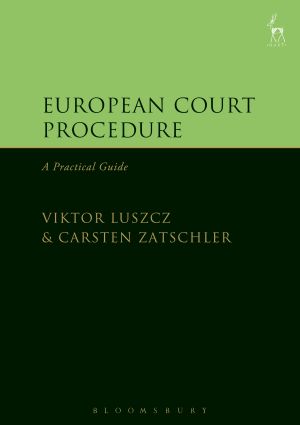
The enforcement of rights and obligations derived from EU law usually begins before national courts or the European Commission, but will sooner or later bring any practitioner in contact with the European Courts based in Luxembourg: the Court of Justice and the General Court of the European Union. Litigation in these two fora is on its surface similar to that in front of national courts but harbours many pitfalls which can trip up even experienced practitioners.
Based on the newly reformed rules of procedure, in force as of January 2012, and written by court insiders, this book gives a detailed but practice-oriented overview of the legal framework and working practices of the European Courts. It aims to give both lawyers appearing for the first time in Luxembourg and those with ample experience of advising on and litigating in EU law a comprehensive reference tool and a guide as to how to present cases most effectively. It covers the whole of the preliminary reference procedure, starting from how to obtain a reference to the Court of Justice in a national court, as well as dealing in detail with all aspects of direct actions against EU institutions brought in the General Court. Aimed primarily at practising lawyers, the work also offers valuable guidance to national judges dealing with cases raising points of EU law and provides insights into the reasoning process of the European Court of interest to scholars in the field.











