
The eBooks we sell are sold as a single-user licence and are intended for the end user only.
The sale of some eBooks are restricted to certain countries. To alert you to such restrictions, please select the country of the billing address of your credit or debit card you wish to use for payment.
For further information see https://www.wildy.com/ebook-formats
Once the order is confirmed an e-mail will be sent to you to allow you to download the eBook. For UK purchases this will be automatic. For purchases outside the UK a member of staff will need to confirm the sale. (Staff are available to do this during normal business hours, Mon-Fri 8:30-17:00 UK time)
All eBooks are supplied firm sale and cannot be returned. If you believe there is a fault with your eBook then contact us on ebooks@wildy.com and we will help in resolving the issue. This does not affect your statutory rights.
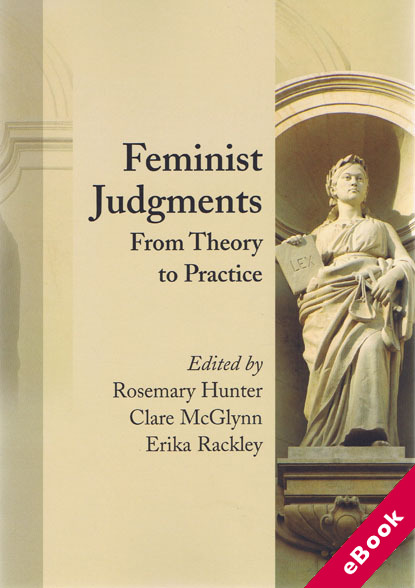
While feminist legal scholarship has thrived within universities and in some sectors of legal practice, it has yet to have much impact within the judiciary or on judicial thinking.
Thus, while feminist legal scholarship has generated comprehensive critiques of existing legal doctrine, there has been little opportunity to test or apply feminist knowledge in practice, in decisions in individual cases. In this book, a group of feminist legal scholars put theory into practice in judgment form, by writing the 'missing' feminist judgments in key cases.
The cases chosen are significant decisions in English law across a broad range of substantive areas. The cases originate from a variety of levels but are primarily opinions of the Court of Appeal or the House of Lords. In some instances they are written in a fictitious appeal, but in others they are written as an additional concurring or dissenting judgment in the original case, providing a powerful illustration of the way in which the case could have been decided differently, even at the time it was heard.
Each case is accompanied by a commentary which renders the judgment accessible to a non-specialist audience. The commentary explains the original decision, its background and doctrinal significance, the issues it raises, and how the feminist judgment deals with them differently.
The books also includes chapters examining the theoretical and conceptual issues raised by the process and practice of feminist judging, and by the judgments themselves, including the possibility of divergent feminist approaches to legal decision-making.










