The eBooks we sell are sold as a single-user licence and are intended for the end user only.
The sale of some eBooks are restricted to certain countries. To alert you to such restrictions, please select the country of the billing address of your credit or debit card you wish to use for payment.
For further information see https://www.wildy.com/ebook-formats
Once the order is confirmed an e-mail will be sent to you to allow you to download the eBook. For UK purchases this will be automatic. For purchases outside the UK a member of staff will need to confirm the sale. (Staff are available to do this during normal business hours, Mon-Fri 8:30-17:00 UK time)
All eBooks are supplied firm sale and cannot be returned. If you believe there is a fault with your eBook then contact us on ebooks@wildy.com and we will help in resolving the issue. This does not affect your statutory rights.
Due to a technical issue some ebooks are not available to order.
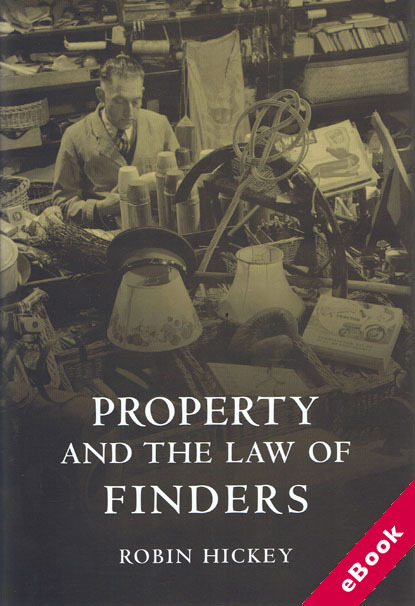
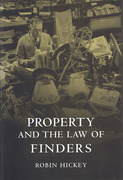
Are finders keepers? This most simple of questions has long evaded a satisfactory legal answer. Generally it seems to have been accepted that a finder acquires a property right in the object of her find and can protect it from subsequent interference, but even this turns out to be the baldest statement of principle, resting on obscure and confused authority.
This first full-length treatment of finders sets them in their legal-historical context, and discovers a fascinating area of law lying at the crossroads of crime, obligations, and property. That on the same facts a finder might be thief, bailee, and/or property right holder has clouded our conceptual analysis, and prevented us from stating simply our rules about finding. Nonetheless, when the applicable doctrines and policies of our property law are explored, and particularly the central concept of possession, we can argue confidently that, despite centuries of doubt and confusion, English law has succeeded in producing a body of law that is theoretically and practically coherent.
Property and the Law of Finders makes this argument, and will appeal to anyone specifically interested in the law of personal property, and also to those with broader concerns about the evolution of common law concepts and their ability to yield workable, practical solutions.
Due to a technical issue some ebooks are not available to order.
Due to a technical issue some ebooks are not available to order.