
The eBooks we sell are sold as a single-user licence and are intended for the end user only.
The sale of some eBooks are restricted to certain countries. To alert you to such restrictions, please select the country of the billing address of your credit or debit card you wish to use for payment.
For further information see https://www.wildy.com/ebook-formats
Once the order is confirmed an e-mail will be sent to you to allow you to download the eBook. For UK purchases this will be automatic. For purchases outside the UK a member of staff will need to confirm the sale. (Staff are available to do this during normal business hours, Mon-Fri 8:30-17:00 UK time)
All eBooks are supplied firm sale and cannot be returned. If you believe there is a fault with your eBook then contact us on ebooks@wildy.com and we will help in resolving the issue. This does not affect your statutory rights.
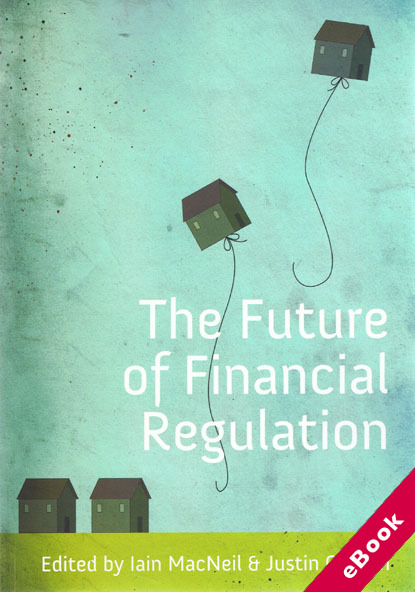
The Future of Financial Regulation is an edited collection of papers presented at a major conference at the University of Glasgow in spring 2009, co-sponsored by the Economic and Social Research Council World Economy and Finance Programme and the the Australian Research Council Governance Research Network.
It draws together a variety of different perspectives on the international financial crisis which began in August 2007 and later turned into a more widespread economic crisis following the collapse of Lehman Brothers in the autumn of 2008.
Spring 2009 was in many respects the nadir since valuations in financial markets had reached their low point and crisis management rather than regulatory reform was the main focus of attention. The conference and book were deliberately framed as an attempt to re-focus attention from the former to the latter.
The first part of the book focuses on the context of the crisis, discussing the general characteristics of financial crises and the specific influences that were at work this time round. The second part focuses more specifically on regulatory techniques and practices implicated in the crisis, noting in particular an over-reliance on the capacity of regulators and financial institutions to manage risk and on the capacity of markets to self-correct.
The third part focuses on the role of governance and ethics in the crisis and in particular the need for a common ethical framework to underpin governance practices and to provide greater clarity in the design of accountability mechanisms.
The final part focuses on the trajectory of regulatory reform, noting the considerable potential for change as a result of the role of the state in the rescue and recuperation of the financial system and stressing the need for fundamental re-appraisal of business and regulatory models.










