The eBooks we sell are sold as a single-user licence and are intended for the end user only.
The sale of some eBooks are restricted to certain countries. To alert you to such restrictions, please select the country of the billing address of your credit or debit card you wish to use for payment.
For further information see https://www.wildy.com/ebook-formats
Once the order is confirmed an e-mail will be sent to you to allow you to download the eBook. For UK purchases this will be automatic. For purchases outside the UK a member of staff will need to confirm the sale. (Staff are available to do this during normal business hours, Mon-Fri 8:30-17:00 UK time)
All eBooks are supplied firm sale and cannot be returned. If you believe there is a fault with your eBook then contact us on ebooks@wildy.com and we will help in resolving the issue. This does not affect your statutory rights.
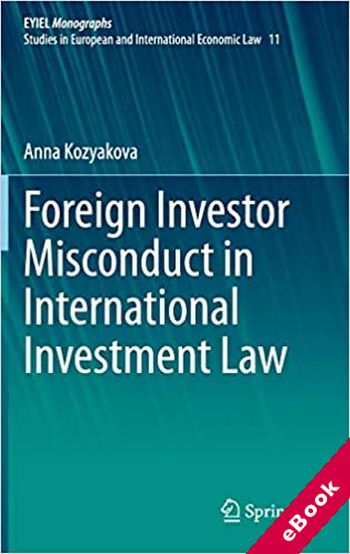
This book examines the issue of foreign investor misconduct in modern international investment law, focusing on the approach that international investment law as it currently operates has developed towards foreign investor misconduct.
The term ‘misconduct’ is not a legal notion, but is used to describe a certain phenomenon, namely, a group/class of actions. This term is convenient since it makes it possible to introduce and describe the phenomenon as such, without a division into concrete types of conduct, like ‘abuse of process’, ‘violation of national law’, ‘corruption’, ‘investment contrary to international norms and standards’, etc. The term ‘misconduct’ is intended to embrace various kinds of conduct on the part of foreign investors that the system of international investment law does not accept – such as that which it regards as illegal, against public policy, or otherwise inappropriate – and triggers legal consequences.
Rarely, however, does international investment law clearly articulate what it considers unacceptable investor conduct, and certainly not in any systematic fashion. As such, this book addresses the following questions: What types of investors’ conduct are legally unacceptable? What mechanisms are available to deal with unacceptable investors’ conduct, and what are the legal consequences?