We will be closed from 5pm BST on Friday 23rd May for the May bank holiday, re-opening at 8.30am BST on Tuesday 26th May. Any orders placed during this period will be processed when we re-open.
The eBooks we sell are sold as a single-user licence and are intended for the end user only.
The sale of some eBooks are restricted to certain countries. To alert you to such restrictions, please select the country of the billing address of your credit or debit card you wish to use for payment.
For further information see https://www.wildy.com/ebook-formats
Once the order is confirmed an e-mail will be sent to you to allow you to download the eBook. For UK purchases this will be automatic. For purchases outside the UK a member of staff will need to confirm the sale. (Staff are available to do this during normal business hours, Mon-Fri 8:30-17:00 UK time)
All eBooks are supplied firm sale and cannot be returned. If you believe there is a fault with your eBook then contact us on ebooks@wildy.com and we will help in resolving the issue. This does not affect your statutory rights.
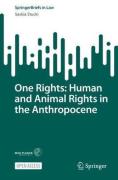
Animals are the traditional blind spot in human rights theory. This book brings together the seemingly disparate discourses of human and animal rights, and looks at emerging animal rights as new human rights. It approaches the question whether animals can and should have human rights through a comprehensive review of contemporary human rights philosophy, discussing both naturalistic and political justifications of human and animal rights. On philosophical as well as practical grounds, this book argues that there are compelling conceptual, principled, and prudential reasons for modernizing the human rights paradigm and integrating animals into its protective mandate.
Moreover, this book proposes the novel One Rights approach as a new (post-)human rights paradigm for the Anthropocene. One Rights advances a holistic understanding of the indivisibility and interdependence of human and animal rights. This book explores how the systematic subjugation, exploitation, and extermination of animals simultaneously contributes to some of the gravest social and environmental threats to human rights, such as animalistic dehumanization and climate change. This book submits that, in light of their socio-political and ecological interconnectedness, human and animal rights are best protected in concert.
The themes of this book are part of a larger conversation about postanthropocentric legal paradigms emerging in the Anthropocene. For human rights to survive in this era of anthropogenic crises, we need to abandon the toxic ideology of human exceptionalism and embrace a more inclusive version of (post-)human rights that tends to the nonhuman. This book intends to show that a holistic One Rights approach promises to achieve better rights-protective outcomes for humans, animals, and their shared planetary home.