
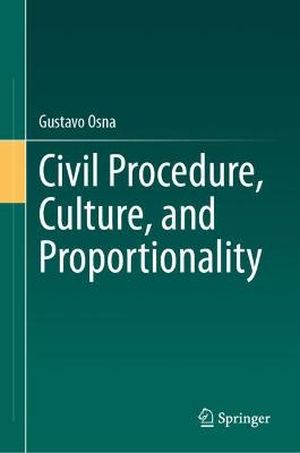
This book contends that civil procedure is a cultural, dynamic practice facing decisive inflection. Rather than treating rules and concepts as fixed dogma, it offers a critical analysis of how adjudication absorbs and responds to shifts in state ideology-from liberal formalism to welfare-oriented publicism-and to real-world constraints such as resource scarcity, bounded rationality, and institutional capacity. Building a comparative dialogue, this book reframes due process as a flexible, proportional safeguard and develops a pan-procedural proportionality that balances the effort devoted to a single case against the needs of the judicial system as a whole. It examines when alternative dispute resolution should complement, not replace, public adjudication; when aggregation (class/collective actions) cures fragmentation and inconsistency; and when structural decisions are necessary to manage policy-laden disputes with broad social effects.
The argument culminates in practical proposals-stronger case management, differentiated procedures, proportional discovery, and participation calibrated to outcomes-that connect theory to practice. By asking whether civil procedure can be genuinely democratic and what "access to justice" should mean beyond mere access to jurisdiction, this book equips readers with conceptual and operational tools to redesign procedure around legitimacy, efficiency, and fairness. It is an invitation to treat procedure as informed choice: coherent premises, transparent trade-offs, and reforms justified by culture, context, and capacity.










