
Wildy Logo
(020) 7242 5778
enquiries@wildy.com

Book of the Month

Cover of Service in Civil Proceedings: Law and Practice

Service in Civil Proceedings: Law and Practice

Price: £150.00

Planning Law:
A Practitioner's Handbook
2nd ed


 William Webster, Robert Weatherley


Welcome to Wildys

Watch


Judicial Cooperation in Commercial Litigation 3rd ed (The British Cross-Border Financial Centre World)


 Ian Kawaley, David Doyle, Shade Subair Williams


Offers for Newly Called Barristers & Students

Special Discounts for Newly Called & Students

Read More ...


Secondhand & Out of Print

Browse Secondhand Online

Read More...


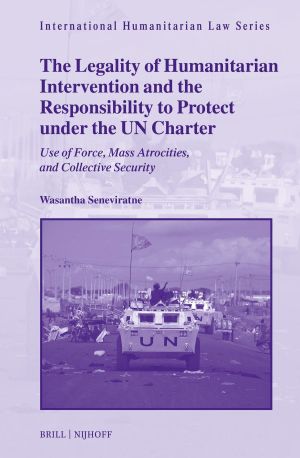
The Legality of Humanitarian Intervention and the Responsibility to Protect under the UN Charter: Use of Force, Mass Atrocities, and Collective Security


ISBN13: 9789004756274
Published: July 2026
Publisher: Brill Academic Publishers
Country of Publication: Netherlands
Format: Hardback
Price: Price on Application


Can international law reconcile the paradox between sovereign equality, the prohibition on the use of force, and the moral imperative to prevent mass atrocity crimes?

This book offers a rigorous analysis of the legality of humanitarian intervention and evaluates the Responsibility to Protect (R2P) as a normative alternative to unilateral force. Drawing on UN Charter interpretation, state practice, case law, and developments from Kosovo to Libya and Syria, it examines how law, power, and legitimacy interact in such interventions. By proposing lawful pathways for collective action when the Security Council is deadlocked, the book advances a principled framework for atrocity prevention within the UN system.


Subjects:
Human Rights and Civil Liberties
Contents:
Preface
Acknowledgements
List of Tables

1. Framing the Debate
 1 The Humanitarian Paradox in the Use of Force
 2 Setting the Context: From Non-intervention to Protection-Based Intervention
 3 Unfolding the Debate: Reconciling Humanity and Sovereignty
 4 Core Argument of the Book
 5 Lines of Inquiry
 6 Aim of the Book
 7 Scope and Focus of the Book
 8 Methodological Approach
 9 Scholarly Contribution and Relevance of the Book
 10 Scholarly Context and Rationale
 11 Scope and Delimitations of the Book
 12 Structure of the Book
 13 Conclusion

2. Founding the Framework
 1 Introduction
 2 Tracing the Roots: Exploration of the Historical and Contextual Foundations of Humanitarian Interventions
 3 Examining the Key Definitions of Humanitarian Interventions
 4 Contested Legacies: Historical Perceptions of Humanitarian Interventions
 5 Shift of Paradigm: From ‘Non-intervention’ to ‘Humanitarian Intervention’
 6 Emergence of Humanitarian Interventions in the Post–Cold War World
 7 Scholarly Opinions on Humanitarian Interventions
 8 Conclusion

3. ‘Prohibition against the Use of Force’
 1 Introduction
 2 Birth of the United Nations and the Changed Parameters of the Legality of International Interventions
 3 Provisions of the United Nations Charter Relating to Humanitarian Interventions
 4 Appraising the Drafting History of Article 2(4)
 5 Article 2(7) of the United Nations Charter
 6 Authorised ‘Exceptions’ to the General Rule of Non-intervention
 7 Resolutions and Declarations Governing International Interventions in the Post–UN Charter Period
 8 Humanitarian Interventions and Case Law Jurisprudence in the Post–UN Charter World Related to the Use of Force
 9 Conclusion

4. ‘Crossing the Grey Area’
 1 Introduction
 2 The Place of Customary Law in Contemporary International Law
 3 From Kosovo to a New Norm? Examining the Potential Role of Customary International Law in Determining the Legality of Humanitarian Intervention
 4 Examining NATO’s Claim of Legality in Kosovo and Its Norm Creating Character as a Precedent for the Future
 5 ECOWAS Interventions in the Post–Cold War World
 6 Need for Effective International Responses to Humanitarian Catastrophes
 7 Conclusion

5. From Humanitarian Intervention to ‘Responsibility to Protect’
 1 Introduction
 2 ‘Responsibility to Protect’ Doctrine: A Brief Overview
 3 International Responses towards the New Initiative
 4 From Consensus to Action: Implementing the Responsibility to Protect in the Post–World Summit World
 5 Evolution of the ‘Responsibility to Protect’ from Theory to Practice: Ensuing Challenges and Opportunities for the Future

6. Conclusion 2756 Prudence of Opening the ‘Pandora’s Box’
 1 Introduction
 2 Unleashing ‘Hope’ from Pandora’s Box: Finding Solutions within the Framework of the UN Charter
 3 ‘In the Shadow of the Veto’: Exploring Alternative Mechanisms to Implement ‘Responsibility to Protect’
 4 Reinvigorating the Pillar System: The Way Forward
 5 Conclusion

7. ‘Untying the Gordian Knot’
 1 Unveiling the Core Findings: Synthesising the Principal Insights
 2 Summary of the Recommendations
 3 Conclusion: Assessing the Legality of Humanitarian Interventions in the Post–Cold War World under the UN Charter
 4 Final Thought and Avenues for Future Research

Bibliography
Index







