
The eBooks we sell are sold as a single-user licence and are intended for the end user only.
The sale of some eBooks are restricted to certain countries. To alert you to such restrictions, please select the country of the billing address of your credit or debit card you wish to use for payment.
For further information see https://www.wildy.com/ebook-formats
Once the order is confirmed an e-mail will be sent to you to allow you to download the eBook. For UK purchases this will be automatic. For purchases outside the UK a member of staff will need to confirm the sale. (Staff are available to do this during normal business hours, Mon-Fri 8:30-17:00 UK time)
All eBooks are supplied firm sale and cannot be returned. If you believe there is a fault with your eBook then contact us on ebooks@wildy.com and we will help in resolving the issue. This does not affect your statutory rights.
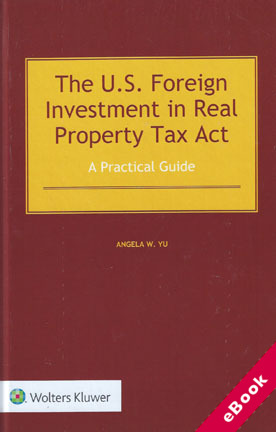
The U.S. Foreign Investment in Real Property Tax Act illustrates the impact of the new Act, U.S. Foreign Investment in Real Property Tax Act (FIRPTA), with practical examples.
U.S. real estate is enormously attractive to many foreign investors, who are thus ushered into the ambit of the complex FIRPTA. A full understanding of the associated tax implications on the part of these investors is essential if they were to implement the correct structure to maximize their returns, avoid unnecessary withholding, and comply with applicable requirements.
This book, the first practical guide to FIRPTA, clearly articulates the operation and transactional implications of FIRPTA, sets forth real-life situations, and points out potential traps, all in a readily comprehensible format.
What’s in this book:
Among the tax issues and consequences that directly or indirectly affect foreign investors in U.S. real property interests, the author highlights the following and more:
This book serves as a handbook for practitioners to gain an understanding of the FIRPTA law, as a whole, its recent changes, and its interaction with various other legal regimes such as the REIT and publicly traded partnership.
Providing a straightforward and accessible guide for navigating the tax issues that confront foreign investors in U.S. real estate, this resource proves invaluable in identifying and formulating the correct strategies for investors and their advisors with respect to investments in the U.S. real estate market. It is sure to benefit all interested parties, academics, and legal counsellors for years to come.











