
The eBooks we sell are sold as a single-user licence and are intended for the end user only.
The sale of some eBooks are restricted to certain countries. To alert you to such restrictions, please select the country of the billing address of your credit or debit card you wish to use for payment.
For further information see https://www.wildy.com/ebook-formats
Once the order is confirmed an e-mail will be sent to you to allow you to download the eBook. For UK purchases this will be automatic. For purchases outside the UK a member of staff will need to confirm the sale. (Staff are available to do this during normal business hours, Mon-Fri 8:30-17:00 UK time)
All eBooks are supplied firm sale and cannot be returned. If you believe there is a fault with your eBook then contact us on ebooks@wildy.com and we will help in resolving the issue. This does not affect your statutory rights.
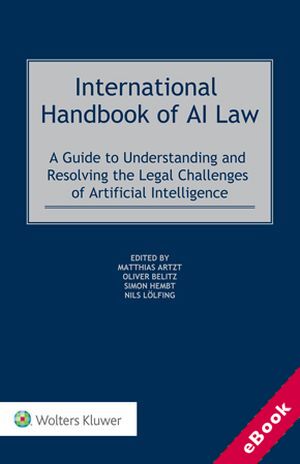
International Handbook of AI Law, an indispensable handbook, written in clear language by international experts from all over the world, elucidates the complex relationship between AI and the law, covering both existing laws and emerging AI-specific legal regulations. Recently, the field of Artificial Intelligence (AI) has seen remarkable advances, revolutionizing how we live, work, and interact with technology. As AI systems grow increasingly sophisticated and autonomous, they raise new and challenging legal questions, particularly regarding AI-specific risks associated with automated systems.
This book commences with a comprehensive and insightful technical analysis of how AI works and progresses with chapters covering a wide array of legal fields relevant to AI technology focusing on the legal framework in the EU.
The topics included are:
The book concludes with country reports on the legal and regulatory environment in the United Kingdom, the United States, China, and Japan, contrasting them with the EU legal framework.
Every chapter provides pragmatic advice on the implementation of legal principles, making the handbook a valuable resource for real-world applications. This essential guide will prove to be immensely valuable to practitioners, policymakers, academics, and others seeking a deep understanding of the complex legal challenges posed by AI use. The handbook aids in responsible and trustworthy AI development and use by guiding decision-making, reducing risks, and protecting the rights and well-being of individuals and society.










