
The eBooks we sell are sold as a single-user licence and are intended for the end user only.
The sale of some eBooks are restricted to certain countries. To alert you to such restrictions, please select the country of the billing address of your credit or debit card you wish to use for payment.
For further information see https://www.wildy.com/ebook-formats
Once the order is confirmed an e-mail will be sent to you to allow you to download the eBook. For UK purchases this will be automatic. For purchases outside the UK a member of staff will need to confirm the sale. (Staff are available to do this during normal business hours, Mon-Fri 8:30-17:00 UK time)
All eBooks are supplied firm sale and cannot be returned. If you believe there is a fault with your eBook then contact us on ebooks@wildy.com and we will help in resolving the issue. This does not affect your statutory rights.
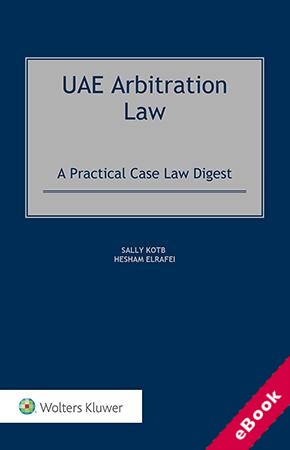
UAE Arbitration Law is a welcome book, the first of its kind to offer in-depth practical case law analysis on arbitration in the United Arab Emirate (UAE), providing an article-by-article guide to the Arbitration Law, with over 120 cases from courts across the Emirates. Each case is presented in the context of its most relevant provision, summarized in English, and accompanied by the authors’ astute comments on the significance and scope of the decision. UAE has taken major steps to enact legislative regimes that permit the efficient and even-handed resolution of international disputes. Federal Law No. 6 of 2018 (Arbitration Law), based on the UNCITRAL Model Law, marks a pivotal step in harmonizing the UAE’s arbitration framework—which includes local arbitration institutions and so-called offshore courts—with global best practices.>
Elucidating the questions that are as challenging as they are important, the authors provide the following:
The authors have meticulously selected decisions to underscore vital legal principles and procedural nuances, always keeping the issues most critical to practitioners at the forefront. The book will, consequently, prove indispensable to anyone practicing international arbitration in the region and will become a go-to resource in the library of any international arbitration counsel, arbitrator, academic or policymaker.










