The eBooks we sell are sold as a single-user licence and are intended for the end user only.
The sale of some eBooks are restricted to certain countries. To alert you to such restrictions, please select the country of the billing address of your credit or debit card you wish to use for payment.
For further information see https://www.wildy.com/ebook-formats
Once the order is confirmed an e-mail will be sent to you to allow you to download the eBook. For UK purchases this will be automatic. For purchases outside the UK a member of staff will need to confirm the sale. (Staff are available to do this during normal business hours, Mon-Fri 8:30-17:00 UK time)
All eBooks are supplied firm sale and cannot be returned. If you believe there is a fault with your eBook then contact us on ebooks@wildy.com and we will help in resolving the issue. This does not affect your statutory rights.
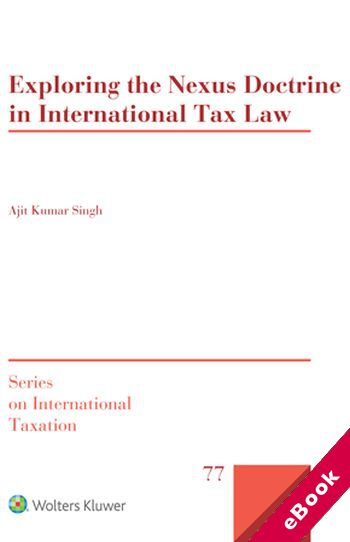
In an age when cross-border business transactions are increasingly effected without the transference of physical products, revenue concerns of states have led to a multitude of tax disputes based on the concept of ‘nexus’. This important and timely book is the most authoritative to date to discuss one of the major tax topics of our time – the question of how taxing rights on income generated from cross-border activities in the digital age should be allocated among jurisdictions.
Demonstrating in prodigious depth that it is the economic nexus of the tax entity or activity with the state, and not the physical nexus, which meets the jurisdictional requirement, the author – a leading authority on this area who is a Senior Commissioner of Income Tax and a Member of the Dispute Resolution Panel of the Government of India – addresses such dimensions of the subject as the following:
The book offers a politically informed analysis of the nexus principle and balances the dynamics of physical presence and economic nexus standards, based on an in-depth survey of the historical evolution of judicial pronouncements and international practices in this regard.
Dr. Singh’s book exposes an urgently needed missing link in the international source rule literature and takes a giant step towards solving the thorny question of appropriate tax apportionment. It sheds brilliant light on the policies states may adopt when signing new tax treaties, so that unintended results may be foreseen and avoided. Tax practitioners, taxation authorities, and academic researchers in the field of international tax law and policy will greatly appreciate the book’s forthright enhancement of the ability to defend challenges based on the nexus doctrine.