We will be closed from 5pm BST on Friday 28th August 2026 for the late summer bank holiday, re-opening at 8.30am BST on Tuesday 1st September. Any orders placed during this period will be processed when we re-open.
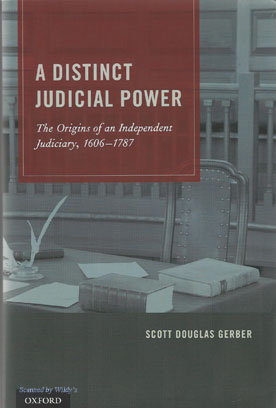
A Distinct Judicial Power: The Origins of an Independent Judiciary, 1606-1787 by Scott Douglas Gerber, provides the first comprehensive critical analysis of the origins of judicial independence in the United States.
Part I examines the political theory of an independent judiciary. Gerber begins chapter 1 by tracing the intellectual origins of a distinct judicial power from Aristotle's theory of a mixed constitution to John Adams's modifications of Montesquieu. Chapter 2 describes the debates during the framing and ratification of the federal Constitution regarding the independence of the federal judiciary.
Part II, the bulk of the book, chronicles how each of the original thirteen states and their colonial antecedents treated their respective judiciaries. This portion, presented in thirteen separate chapters, brings together a wealth of information (charters, instructions, statutes, etc.) about the judicial power between 1606 and 1787, and sometimes beyond.
Part III, the concluding segment, explores the influence the colonial and early state experiences had on the federal model that followed and on the nature of the regime itself. It explains how the political theory of an independent judiciary examined in Part I, and the various experiences of the original thirteen states and their colonial antecedents chronicled in Part II, culminated in Article III of the U.S. Constitution.
It also explains how the principle of judicial independence embodied by Article III made the doctrine of judicial review possible, and committed that doctrine to the protection of individual rights.