The eBooks we sell are sold as a single-user licence and are intended for the end user only.
The sale of some eBooks are restricted to certain countries. To alert you to such restrictions, please select the country of the billing address of your credit or debit card you wish to use for payment.
For further information see https://www.wildy.com/ebook-formats
Once the order is confirmed an e-mail will be sent to you to allow you to download the eBook. For UK purchases this will be automatic. For purchases outside the UK a member of staff will need to confirm the sale. (Staff are available to do this during normal business hours, Mon-Fri 8:30-17:00 UK time)
All eBooks are supplied firm sale and cannot be returned. If you believe there is a fault with your eBook then contact us on ebooks@wildy.com and we will help in resolving the issue. This does not affect your statutory rights.
Due to a technical issue some ebooks are not available to order.
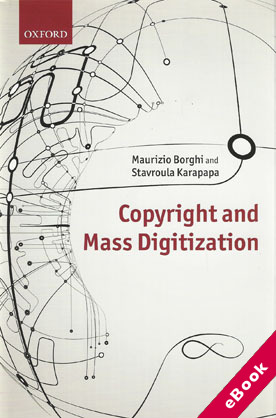
In an age where works are increasingly being used, not only as works in the traditional sense, but also as carriers of data from which information may be automatically extracted for various purposes, Borghi and Karapapa consider whether mass digitisation is consistent with existing copyright principles, and ultimately whether copyright protection needs to be redefined, and if so how?
The work considers the activities involved in the process of mass digitization identifying impediments to the increasing number of such projects such as the inapplicability of copyright exceptions, difficulties in rights clearance, and the issue of 'orphan' and out-of-print works.
It goes on to examine the concept of 'use' of works in light of mass digital technologies and how it impinges on copyright law and principles; for example considering whether scanning and using optical character recognition in mass digital projects qualify as transformative use, or whether text mining on digitial repositories should be a permitted activity.
These issues are considered in the context of both European and US law. Consideration is also given to mass digitization in the wider context of 'law and technology', comparing mass digitization issues with those of genetic databases, online privacy and data protection.
Illustrating how mass digitization unveils a number of unsettled theoretical issues within copyright, the book proposes a new regulatory framework for the use of works in the context of emerging technologies, providing a new rights-based approach to dealing with copyright.