
Wildy Logo
(020) 7242 5778
enquiries@wildy.com

Book of the Month

Cover of McMeel on the Construction of Contracts: Interpretation, Implication and Rectification

McMeel on the Construction of Contracts: Interpretation, Implication and Rectification

Price: £225.00

Land Registration Manual
4th ed


 Ash Jones


Welcome to Wildys

Watch


Judicial Cooperation in Commercial Litigation 3rd ed (The British Cross-Border Financial Centre World)


 Ian Kawaley, David Doyle, Shade Subair Williams


Offers for Newly Called Barristers & Students

Special Discounts for Newly Called & Students

Read More ...


Secondhand & Out of Print

Browse Secondhand Online

Read More...


2025-6 Christmas and New Year Closing

We are now closed for the Christmas and New Year period, returning on Monday 5th January 2026. Orders placed during this time will be processed upon our return on 5th January.

Hide this message

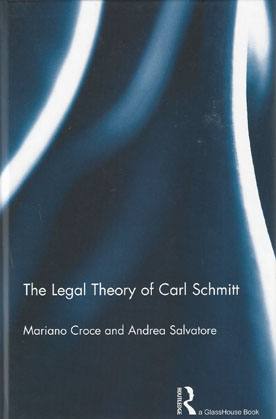
The Legal Theory of Carl Schmitt


ISBN13: 9781138780842
Published: March 2014
Publisher: Routledge
Country of Publication: UK
Format: Paperback (Hardback in 2012)
Price: £53.99
Hardback edition , ISBN13 9780415683494


Despatched in 4 to 6 days.

The Legal Theory of Carl Schmitt provides a detailed analysis of this thinker, who was so crucial to the development of Western legal thought. Recently, Carl Schmitt has become a significant figure in debates about the relationship between law and politics, at both a national and a global level.

In spite of his prominence, however, Schmitt's legal thinking has received little specific attention. Here, Mariano Croce and Andrea Salvatore provide a thorough account of Schmitt's theoretical framework. Going beyond the usual, narrow, consideration of Schmitt's main themes - such as sovereignty, decisionism, political theology, and the friend/enemy distinction - this framework, they argue, is able to overcome the weaknesses of other legal theoretical and jurisprudential paradigms.


Subjects:
Jurisprudence
Contents:
Introduction

Part 1. Concepts: institutions, decision, concrete order
Chapter 1. The three souls of legal science
Chapter 2. Schmitt's way-out from decisionism
Chapter 3. The concrete order as the material fabric of law

Part 2. Oppositions: his "enemies" and "friends"
Chapter 4. Schmitt vs. Kelsen: positivism as a heteronymous, abstract and dangerous theory
Chapter 5. Schmitt vs. Hauriou: the tyranny of an individualistic concrete order
Chapter 6. Schmitt vs. Romano: the inconceivability of legal pluralism
Chapter 7. Schmitt vs. Mortati: concrete order or material constitution?

Part 3. Implications: past, present, future
Chapter 8. Is the state order an instance of concrete order?
Chapter 9. Is the post-state order an instance of concrete order?
Chapter 10. Rule of law vs. Concrete order.







