The eBooks we sell are sold as a single-user licence and are intended for the end user only.
The sale of some eBooks are restricted to certain countries. To alert you to such restrictions, please select the country of the billing address of your credit or debit card you wish to use for payment.
For further information see https://www.wildy.com/ebook-formats
Once the order is confirmed an e-mail will be sent to you to allow you to download the eBook. For UK purchases this will be automatic. For purchases outside the UK a member of staff will need to confirm the sale. (Staff are available to do this during normal business hours, Mon-Fri 8:30-17:00 UK time)
All eBooks are supplied firm sale and cannot be returned. If you believe there is a fault with your eBook then contact us on ebooks@wildy.com and we will help in resolving the issue. This does not affect your statutory rights.
Due to a technical issue some ebooks are not available to order.
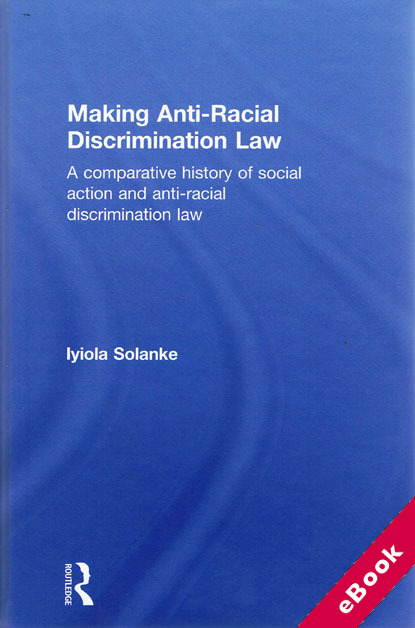
Making Anti- Racial Discrimination Law examines the evolution of anti-racial discrimination law from a socio-legal perspective. Taking a comparative and interdisciplinary approach, the book does not simply look at race and society or race and law but brings these areas together by drawing out the tension in the process, in different countries, by which race becomes a policy issue which is subsequently regulated by law.
Moving beyond traditional social movement theory to include the extreme right wing as a social actor, the study identifies the role of extreme right wing confrontation in agenda setting and law-making, a feature often neglected in studies of social action. In so doing, it identifies the influence of both the extreme right and liberalism on anti-racial discrimination law.
Focusing primarily on Great Britain and Germany, the book also demonstrates how national politics feeds into EU policy and identifies some of the challenges in creating a high and uniform level of protection against racial discrimination throughout the EU. Using primary archival materials from Germany and the UK, the empirical richness of this book constitutes a valuable contribution to the field of anti-racial discrimination law, at both undergraduate and postgraduate level.
The book will interest specialists and academics in law, sociology and political science as well as non-specialists, who will find this study stimulating and useful to expand their knowledge of anti-racial discrimination law or pursue teaching goals, policy objectives and reform agendas.