
The eBooks we sell are sold as a single-user licence and are intended for the end user only.
The sale of some eBooks are restricted to certain countries. To alert you to such restrictions, please select the country of the billing address of your credit or debit card you wish to use for payment.
For further information see https://www.wildy.com/ebook-formats
Once the order is confirmed an e-mail will be sent to you to allow you to download the eBook. For UK purchases this will be automatic. For purchases outside the UK a member of staff will need to confirm the sale. (Staff are available to do this during normal business hours, Mon-Fri 8:30-17:00 UK time)
All eBooks are supplied firm sale and cannot be returned. If you believe there is a fault with your eBook then contact us on ebooks@wildy.com and we will help in resolving the issue. This does not affect your statutory rights.
Due to a technical issue some ebooks are not available to order.
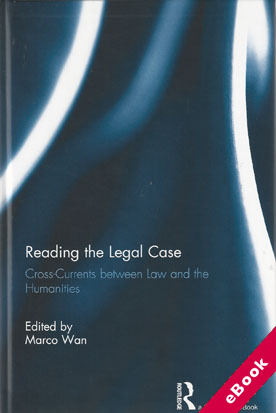
Reading the Legal Case: Cross-Currents in Law and the Humanities re-examines the seemingly familiar notion of a ‘legal case’ by exploring the histories, practices, conventions and rhetoric of ‘case law’.
The doctrine of stare decisis, whereby courts are bound by precedent cases, underpins legal reasoning in the common law world. At the same time, the legal case is itself a product of institutional and linguistic practices, and raises broader questions about the foundations and boundaries of law.
The idea of the ‘case’ as an ordered, closed narrative with a determinate outcome is, for example, integral to medical, psychoanalytic, as well as forensic discourses; whilst the notion of the ‘strange case’ is a popular one in the English fiction of the late nineteenth century. What is at stake in the attempt to categorise or define a situation as a legal case?
Is the notion of binding precedent in ‘case law’ really distinctive to the common law? And if so, why? What can the concept of a ‘case’ in other disciplines and discourses tell us about how it operates in law? With contributions from legal philosophers, legal historians, literary critics, and linguists, this book moves beyond the jurisprudential discussion of the nature and authority of the legal case, as it draws on insights from philosophy, m linguistics, narratology, drama, and film.










