The eBooks we sell are sold as a single-user licence and are intended for the end user only.
The sale of some eBooks are restricted to certain countries. To alert you to such restrictions, please select the country of the billing address of your credit or debit card you wish to use for payment.
For further information see https://www.wildy.com/ebook-formats
Once the order is confirmed an e-mail will be sent to you to allow you to download the eBook. For UK purchases this will be automatic. For purchases outside the UK a member of staff will need to confirm the sale. (Staff are available to do this during normal business hours, Mon-Fri 8:30-17:00 UK time)
All eBooks are supplied firm sale and cannot be returned. If you believe there is a fault with your eBook then contact us on ebooks@wildy.com and we will help in resolving the issue. This does not affect your statutory rights.
Due to a technical issue some ebooks are not available to order.
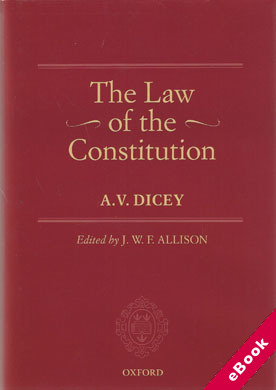
The Law of the Constitution has been the main doctrinal influence upon English constitutional thought since the late-nineteenth century.
It acquired and long retained extraordinary legal authority, despite fierce criticism and many changes in law and government. By many, it was treated as a canonical text embodying axiomatic principles, or it was simply understood as indeed the law of the constitution; and even by its critics, it was still granted the status of orthodoxy.
Basic constitutional principles became commonly conceived in Diceyan terms: parliamentary sovereignty was pure and absolute in being without legal limit; and Dicey's rule of law precluded recognition of an English administrative law and thus retarded its development for decades. Reaffirmed in each new edition of Dicey's canonical text, the constitution itself seemed static.
The Oxford Edition of Dicey provides sources with which to reassess the extraordinary authority and lasting influence of Dicey's canonical text. This volume consists of Dicey's rare first edition in its original lecture form and of the main addenda in later editions. It facilitates a historical understanding of Dicey's original text in its context and of later changes when they were made.
In introducing the first volume, J.W.F. Allison reassesses The Law of the Constitution'sauthority and the kinds of response it has elicited in view of its original educative form and educational context.