
The eBooks we sell are sold as a single-user licence and are intended for the end user only.
The sale of some eBooks are restricted to certain countries. To alert you to such restrictions, please select the country of the billing address of your credit or debit card you wish to use for payment.
For further information see https://www.wildy.com/ebook-formats
Once the order is confirmed an e-mail will be sent to you to allow you to download the eBook. For UK purchases this will be automatic. For purchases outside the UK a member of staff will need to confirm the sale. (Staff are available to do this during normal business hours, Mon-Fri 8:30-17:00 UK time)
All eBooks are supplied firm sale and cannot be returned. If you believe there is a fault with your eBook then contact us on ebooks@wildy.com and we will help in resolving the issue. This does not affect your statutory rights.
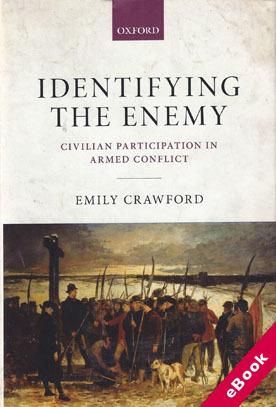
Over the past twenty-five years, significant changes in the conduct of wars have increasingly placed civilians in traditional military roles - employing civilians to execute drone strikes, the 'targeted killing' of suspected terrorists, the use of private security contractors in combat zones, and the spread of cyber attacks. Under the laws of armed conflict, civilians cannot be targeted unless they take direct part in hostilities. Once civilians take action, they become targets.
This book analyses the complex question of how to identify just who those civilians are. Identifying the Enemy examines the history of civilian participation in armed conflict and how the law has responded to such action. It asks the crucial question: what is 'direct participation in hostilities'?
The book slices through the attempts to untie this Gordian knot, and shows that the changing nature of warfare has called into question the very foundation of the civilian/military dichotomy that is at the heart of the law of armed conflict.










