The eBooks we sell are sold as a single-user licence and are intended for the end user only.
The sale of some eBooks are restricted to certain countries. To alert you to such restrictions, please select the country of the billing address of your credit or debit card you wish to use for payment.
For further information see https://www.wildy.com/ebook-formats
Once the order is confirmed an e-mail will be sent to you to allow you to download the eBook. For UK purchases this will be automatic. For purchases outside the UK a member of staff will need to confirm the sale. (Staff are available to do this during normal business hours, Mon-Fri 8:30-17:00 UK time)
All eBooks are supplied firm sale and cannot be returned. If you believe there is a fault with your eBook then contact us on ebooks@wildy.com and we will help in resolving the issue. This does not affect your statutory rights.
Due to a technical issue some ebooks are not available to order.
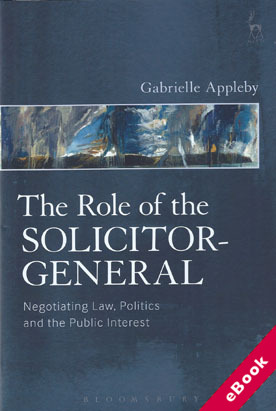
Behind every government there is an impressive team of hard-working government lawyers. In Australia, the Solicitor-General leads that team. A former Attorney-General once said: 'The Solicitor-General is next to the High Court and God.' And yet, the role of government lawyers in Australia, and specifically the Solicitor-General as the most senior of government lawyers, is under-theorised and under-studied.
The Role of the Solicitor-General goes behind the scenes of government - drawing from interviews with over 45 government and judicial officials - to uncover the history, theory and practice of the Australian Solicitor-General. The analysis reveals a role that is of fundamental constitutional importance to ensuring both the legality and the integrity of government action, thus contributing to the achievement of rule of law ideals. The Solicitor-General also works to defend government action and prosecute government policies in the court, and thus performs an important role as messenger between the political and judicial branches of government.
But the Solicitor-General's position, as both an internal integrity check on government and an external warrior for government gives rise to competing pressures: between the law, politics and the public interest. The Australian Solicitor-General has evolved many unique characteristics across the almost two centuries of its history in an attempt to navigate the tensions inherent in the office. These pressures are not unique to the Australian context. The understanding of the Australian framework provided by this book is informed by, and will inform, comparative analysis of the role of government lawyers across the world.