The eBooks we sell are sold as a single-user licence and are intended for the end user only.
The sale of some eBooks are restricted to certain countries. To alert you to such restrictions, please select the country of the billing address of your credit or debit card you wish to use for payment.
For further information see https://www.wildy.com/ebook-formats
Once the order is confirmed an e-mail will be sent to you to allow you to download the eBook. For UK purchases this will be automatic. For purchases outside the UK a member of staff will need to confirm the sale. (Staff are available to do this during normal business hours, Mon-Fri 8:30-17:00 UK time)
All eBooks are supplied firm sale and cannot be returned. If you believe there is a fault with your eBook then contact us on ebooks@wildy.com and we will help in resolving the issue. This does not affect your statutory rights.
Due to a technical issue some ebooks are not available to order.
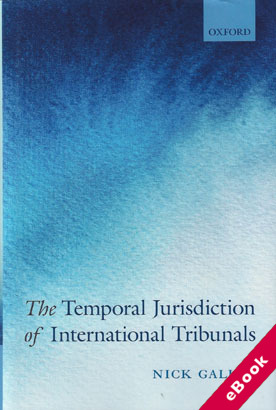
The period of an international tribunal's temporal jurisdiction is the span of time during which an act must have occurred before the tribunal may consider if the act breached an obligation.
There are many questions concerning this particular aspect of an international tribunal's jurisdiction: Does a tribunal have power over acts that occurred after the entry into force of the obligation allegedly breached, but before the tribunal's jurisdiction was accepted? What about acts that began before the tribunal's jurisdiction was accepted but continued after?
To what extent can acts before the period of the tribunal's jurisdiction affect its decision on whether or not there is a breach through acts afterwards? The Temporal Jurisdiction of International Tribunals examines these questions in depth.
Despite its importance, the temporal jurisdiction of international tribunals is not well understood. Tribunals often confuse different aspects of their jurisdiction and refuse to hear cases they should have heard, or agree to hear cases they should not.
This book reduces this confusion by clarifying the different limits on the temporal jurisdiction of international tribunals and the important distinctions between those limits. The book examines the temporal limits resulting from (i) the entry into force of the obligation supposedly breached, (ii) the acceptance of the tribunal's jurisdiction, and (iii) from the period of limitation, as well as the effect of acts that occurred before these limits.
Throughout the book, the author comprehensively compares decisions from a wide variety of sources, including the International Court of Justice, Human Rights Courts, World Trade Organization panels, and investment treaty tribunals. It comments on decisions that arose from some of the most notorious events of the twentieth century, including the "Katyn Massacre" of the Second World War, the 1994 Rwandan genocide, and the "forced disappearance" of American political opponents.
It reviews these decisions and identifies common principles that help define the temporal jurisdiction of tribunals to decide breaches of international law. This book is essential for anyone practicing in international law, and anyone building a case that could be affected by temporal jurisdiction.