The eBooks we sell are sold as a single-user licence and are intended for the end user only.
The sale of some eBooks are restricted to certain countries. To alert you to such restrictions, please select the country of the billing address of your credit or debit card you wish to use for payment.
For further information see https://www.wildy.com/ebook-formats
Once the order is confirmed an e-mail will be sent to you to allow you to download the eBook. For UK purchases this will be automatic. For purchases outside the UK a member of staff will need to confirm the sale. (Staff are available to do this during normal business hours, Mon-Fri 8:30-17:00 UK time)
All eBooks are supplied firm sale and cannot be returned. If you believe there is a fault with your eBook then contact us on ebooks@wildy.com and we will help in resolving the issue. This does not affect your statutory rights.
Due to a technical issue some ebooks are not available to order.
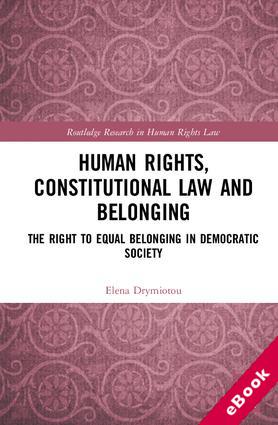
While every constitution includes a provision over the right to equal protection of the laws, perhaps with different terminology, this book interprets this right in a new way. Theories of the right to equal protection of the laws as the right to anti-subordination are the most influential theories for the suggested one. However, they are not the same. Elena Drymiotou suggests to understand the right to equal protection of the laws right in terms of belonging. She goes on to identify certain criteria and she offers a general theory of the Right to Democratic Belonging. This book uses political theory, constitutional provisions, and case law to suggest this new theory of the right to equal protection of the laws; the theory of the Right to Equal Belonging in a Democratic Society or in other words, the Right to Democratic Belonging.
Human Rights and Equal Belonging in a Democratic Society is the starting point of a more comprehensive theory of the right to democratic belonging. It will be of interest both to students at an advanced level, academics and reflective practitioners. It addresses the topics with regard to human rights and equality and will be of interest to researchers, academics, policymakers, and students in the fields of human rights law, constitutional law, and legal theory.