The eBooks we sell are sold as a single-user licence and are intended for the end user only.
The sale of some eBooks are restricted to certain countries. To alert you to such restrictions, please select the country of the billing address of your credit or debit card you wish to use for payment.
For further information see https://www.wildy.com/ebook-formats
Once the order is confirmed an e-mail will be sent to you to allow you to download the eBook. For UK purchases this will be automatic. For purchases outside the UK a member of staff will need to confirm the sale. (Staff are available to do this during normal business hours, Mon-Fri 8:30-17:00 UK time)
All eBooks are supplied firm sale and cannot be returned. If you believe there is a fault with your eBook then contact us on ebooks@wildy.com and we will help in resolving the issue. This does not affect your statutory rights.
Due to a technical issue some ebooks are not available to order.
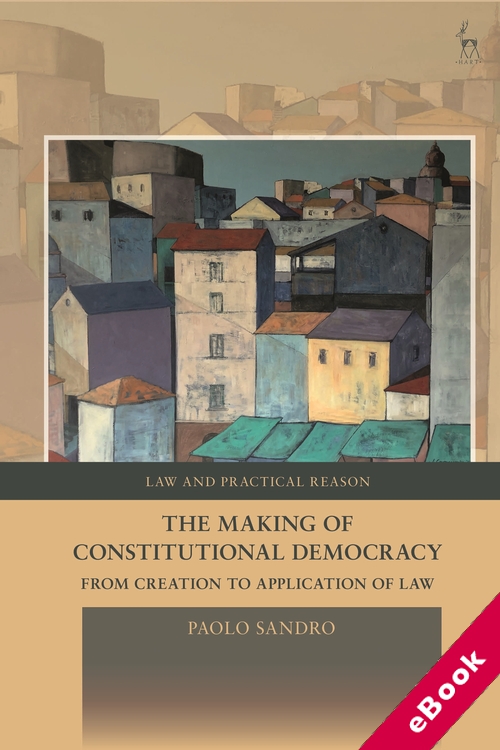
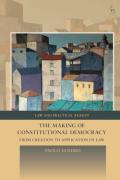
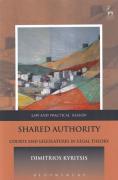
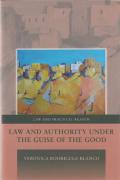
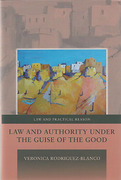
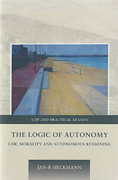
This book addresses a palpable, yet widely neglected, tension in legal discourse. In our everyday legal practices – whether taking place in a courtroom, classroom, law firm, or elsewhere – we routinely and unproblematically talk of the activities of creating and applying law. However, when legal scholars have analysed this distinction in their theories (rather than simply assuming it), many have undermined it, if not dismissed it as untenable.
The book considers the relevance of distinguishing between law-creation and law-application and how this transcends the boundaries of jurisprudential enquiry. It argues that such a distinction is also a crucial component of political theory. For if there is no possibility of applying a legal rule that was created by a different institution at a previous moment in time, then our current constitutional-democratic frameworks are effectively empty vessels that conceal a power relationship between public authorities and citizens that is very different from the one on which constitutional democracy is grounded.
After problematising the most relevant objections in the literature, the book presents a comprehensive defence of the distinction between creation and application of law within the structure of constitutional democracy. It does so through an integrated jurisprudential methodology, which combines insights from different disciplines (including history, anthropology, political science, philosophy of language, and philosophy of action) while also casting new light on long-standing issues in public law, such as the role of legal discretion in the law-making process and the scope of the separation of powers doctrine.



Due to a technical issue some ebooks are not available to order.

Due to a technical issue some ebooks are not available to order.




Due to a technical issue some ebooks are not available to order.
Due to a technical issue some ebooks are not available to order.


Due to a technical issue some ebooks are not available to order.

Due to a technical issue some ebooks are not available to order.


Due to a technical issue some ebooks are not available to order.
Due to a technical issue some ebooks are not available to order.
Due to a technical issue some ebooks are not available to order.
Due to a technical issue some ebooks are not available to order.
Due to a technical issue some ebooks are not available to order.
Due to a technical issue some ebooks are not available to order.
Due to a technical issue some ebooks are not available to order.
Due to a technical issue some ebooks are not available to order.
Due to a technical issue some ebooks are not available to order.
Due to a technical issue some ebooks are not available to order.