
The eBooks we sell are sold as a single-user licence and are intended for the end user only.
The sale of some eBooks are restricted to certain countries. To alert you to such restrictions, please select the country of the billing address of your credit or debit card you wish to use for payment.
For further information see https://www.wildy.com/ebook-formats
Once the order is confirmed an e-mail will be sent to you to allow you to download the eBook. For UK purchases this will be automatic. For purchases outside the UK a member of staff will need to confirm the sale. (Staff are available to do this during normal business hours, Mon-Fri 8:30-17:00 UK time)
All eBooks are supplied firm sale and cannot be returned. If you believe there is a fault with your eBook then contact us on ebooks@wildy.com and we will help in resolving the issue. This does not affect your statutory rights.
Due to a technical issue some ebooks are not available to order.
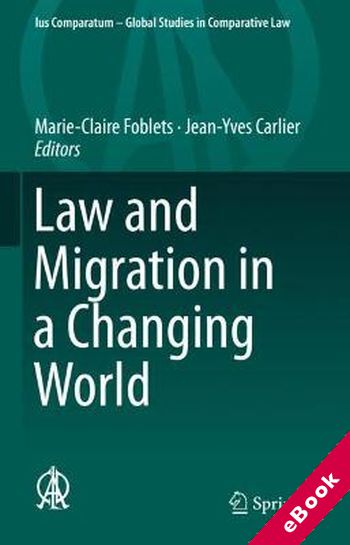
This volume comprises national reports on migration and migration law from 17 countries representing all continents. The vast majority of these are countries of immigration, which means they face specific challenges in terms of managing migratory flows that are increasingly linked with climate change and scarce natural resources worldwide, and they need to find viable ways to integrate humanitarian migration. Unlike so many recent publications in the field of international migration law, this book brings together reports on diverse countries that are rarely regarded as part of one and the same picture, depicting globalized migration in the contemporary era that to a large extent challenges state sovereignty. The contributions delineate the legal regimes that individual states are continually developing and modifying with a view to managing and controlling access of individual persons to their respective territories. They also show how the restrictive measures that states resort to in the event of failure to manage migration could have a lasting legal impact.
The General Report preceding the country reports provides a comparative overview of the national reports, and is divided into two parts. The first, more technical in nature, addresses the classic questions relating to admission to and residence in a country. The second, more reflective section, examines the relationship between laws and migration in a wider and multidisciplinary perspective. To allow a robust comparison, the country reports all follow a similarly wide-ranging structure; to the extent possible, they also cover the historical, sociological and demographic factors that help explain legal regimes and migratory flows in each country. Each country report includes analyses of recent legislative developments and delicate questions that are still awaiting adequate (legal) responses as well as perspectives for the future.










