The eBooks we sell are sold as a single-user licence and are intended for the end user only.
The sale of some eBooks are restricted to certain countries. To alert you to such restrictions, please select the country of the billing address of your credit or debit card you wish to use for payment.
For further information see https://www.wildy.com/ebook-formats
Once the order is confirmed an e-mail will be sent to you to allow you to download the eBook. For UK purchases this will be automatic. For purchases outside the UK a member of staff will need to confirm the sale. (Staff are available to do this during normal business hours, Mon-Fri 8:30-17:00 UK time)
All eBooks are supplied firm sale and cannot be returned. If you believe there is a fault with your eBook then contact us on ebooks@wildy.com and we will help in resolving the issue. This does not affect your statutory rights.
Due to a technical issue some ebooks are not available to order.
The increased interest in international arbitration as a method of dispute resolution in cross-border contracts, and the widespread practice of including arbitration clauses in such contracts, means that practitioners are often called upon to advice on disputes which will be heard abroad. Ready access to the relevant arbitration laws in force at the seat (or potential seat) of the arbitration is essential.
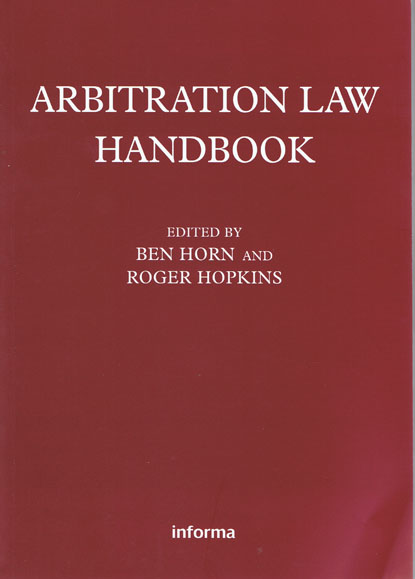
The Arbitration Handbook collects together in one volume the laws in force in more than twenty countries, with the main procedural rules used in each of those countries. Each section has a short introduction identifying relevant treaty obligations, the main arbitral bodies and the principal laws in force.
Additionally, there is an international section in which the UNCITRAL Model Law and Arbitration Rules are set out and in which the major international conventions relating to arbitration, such as the New York Convention and table of signatories, are reproduced. The section also includes the ICSID Arbitration Rules (applicable to the settlement of investment disputes), as well as those of WIPO (applicable to the settlement of intellectual property disputes).
Anyone engaged in international arbitration will find this book an indispensable reference guide to the arbitration laws in force in the world's major arbitration centres, as well as the main procedural rules of the important national institutional bodies which promulgate their own rules.