The eBooks we sell are sold as a single-user licence and are intended for the end user only.
The sale of some eBooks are restricted to certain countries. To alert you to such restrictions, please select the country of the billing address of your credit or debit card you wish to use for payment.
For further information see https://www.wildy.com/ebook-formats
Once the order is confirmed an e-mail will be sent to you to allow you to download the eBook. For UK purchases this will be automatic. For purchases outside the UK a member of staff will need to confirm the sale. (Staff are available to do this during normal business hours, Mon-Fri 8:30-17:00 UK time)
All eBooks are supplied firm sale and cannot be returned. If you believe there is a fault with your eBook then contact us on ebooks@wildy.com and we will help in resolving the issue. This does not affect your statutory rights.
Due to a technical issue some ebooks are not available to order.
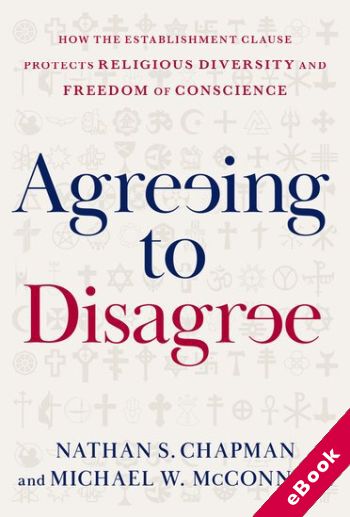
In one of the most thorough accounts of the Establishment Clause of the First Amendment, Michael W. McConnell and Nathan S. Chapman provide an insightful overview of the legal history and meaning of the clause, as well as its value for promoting equal religious freedom and diversity in contemporary America.
The Establishment Clause of the First Amendment, "Congress shall make no law respecting an establishment of religion", may be the most contentious and misunderstood provision of the entire U.S. Constitution. It lies at the heart of America's culture wars. But what, exactly, is an "establishment of religion"? And what is a law "respecting" it?
Many commentators reduce the clause to "the separation of church and state." This implies that church and state are at odds, that the public sphere must be secular, and that the Establishment Clause is in tension with the Free Exercise of Religion Clause. All of these implications misconstrue the Establishment Clause's original purpose and enduring value for a religiously pluralistic society. The clause facilitates religious diversity and guarantees equality of religious freedom by prohibiting the government from coercing or inducing citizens to change their religious beliefs and practices.
In Agreeing to Disagree, Michael W. McConnell and Nathan S. Chapman detail the theological, political, and philosophical underpinnings of the Establishment Clause, state disestablishment, and the disestablishment norms applied to the states by the Fourteenth Amendment. Americans in the early Republic were intimately acquainted with the laws used in England, the colonies, and early states to enforce religious uniformity. The Establishment Clause was understood to prohibit the government from incentivizing such uniformity. Chapman and McConnell show how the U.S. Supreme Court has largely implemented these purposes in cases addressing prayer in school, state funding of religious schools, religious symbols on public property, and limits on religious accommodations. In one of the most thorough accounts of the Establishment Clause, McConnell and Chapman argue that the clause is best understood as a constitutional commitment for Americans to agree to disagree about matters of faith.

Due to a technical issue some ebooks are not available to order.