The eBooks we sell are sold as a single-user licence and are intended for the end user only.
The sale of some eBooks are restricted to certain countries. To alert you to such restrictions, please select the country of the billing address of your credit or debit card you wish to use for payment.
For further information see https://www.wildy.com/ebook-formats
Once the order is confirmed an e-mail will be sent to you to allow you to download the eBook. For UK purchases this will be automatic. For purchases outside the UK a member of staff will need to confirm the sale. (Staff are available to do this during normal business hours, Mon-Fri 8:30-17:00 UK time)
All eBooks are supplied firm sale and cannot be returned. If you believe there is a fault with your eBook then contact us on ebooks@wildy.com and we will help in resolving the issue. This does not affect your statutory rights.
Due to a technical issue some ebooks are not available to order.
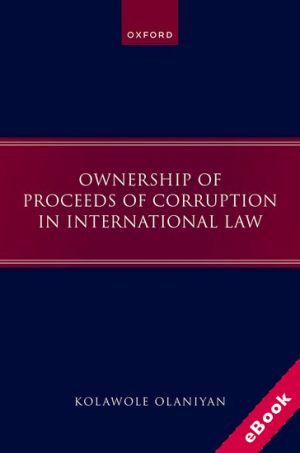
Recovery of proceeds deriving from corruption is now increasingly recognised as a principle of contemporary international law. However, people's sovereign and ownership rights over their wealth and natural resources have remained more theoretical than real, especially in the global fight against corruption. As a result, the populations of victim-states often cannot hold their governments accountable for misusing proceeds of corruption, and do not benefit from the recovery, repatriation, management, and use of returned proceeds. In the first comprehensive study on the issue, Kolawole Olaniyan challenges the conventional notion that sovereign and ownership rights over wealth and natural resources - and by extension, the proceeds of corruption - should be exclusively exercised by States.
Olaniyan's Ownership of Proceeds of Corruption in International Law examines the relationship between the right to wealth and natural resources, proceeds of corruption, and economic activities. Focusing on victims of corruption, the book argues that victim-states' populations ought to be empowered to pursue grand corruption and asset recovery actions against their governments. It proposes theoretical and legal remedies for recovering proceeds of corruption, encouraging the development of domestic laws.