The eBooks we sell are sold as a single-user licence and are intended for the end user only.
The sale of some eBooks are restricted to certain countries. To alert you to such restrictions, please select the country of the billing address of your credit or debit card you wish to use for payment.
For further information see https://www.wildy.com/ebook-formats
Once the order is confirmed an e-mail will be sent to you to allow you to download the eBook. For UK purchases this will be automatic. For purchases outside the UK a member of staff will need to confirm the sale. (Staff are available to do this during normal business hours, Mon-Fri 8:30-17:00 UK time)
All eBooks are supplied firm sale and cannot be returned. If you believe there is a fault with your eBook then contact us on ebooks@wildy.com and we will help in resolving the issue. This does not affect your statutory rights.
Due to a technical issue some ebooks are not available to order.
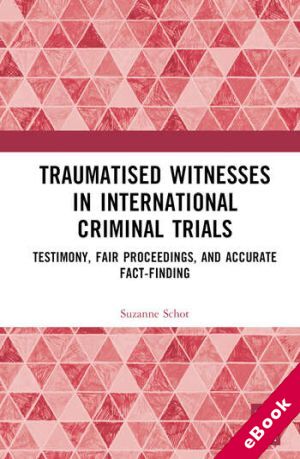
This book focuses on the testimonial evidence of traumatised witnesses in trials of international crimes, which deal with acts of genocide, war crimes and crimes against humanity. Such trials often involve the testimonies of those who experienced or witnessed extremely traumatic events, which can make it hard for these witnesses to recall specific details. Testifying during trial may in itself also pose challenges to their well-being. Yet the legal process of determining whether someone can be held criminally responsible for the alleged crimes needs to be fair, in accordance with the right to a fair trial of the accused, and the facts need to be determined as accurately as possible. This book argues that to ensure fair and accurate fact-finding when in particular traumatised witnesses testify, a balance needs to be struck between the needs of witnesses who testify about traumatic experiences, the fair trial rights of the accused, and the objective of the court to establish as accurately as possible the responsibility of the accused. This is crucial throughout the stages of selecting, preparing, presenting and assessing the testimonial evidence of traumatised witnesses. The methodology involves an analysis of transcripts of proceedings and case law of the International Criminal Tribunal for the former Yugoslavia, the International Criminal Court, and Dutch courts prosecuting international crimes. The research demonstrates that it is often difficult to strike a balance between the competing objectives during proceedings when traumatised witnesses testify due to the current lack of regulations and guidelines applicable during investigations and prosecutions. This book shows that this balance can, and should, be achieved when traumatised witnesses testify during criminal proceedings for international crimes. The work is an invaluable resource for researchers, academics and practitioners in criminal law, criminology, legal-psychology, legal-psychiatry, social anthropology and forensic sciences.