The eBooks we sell are sold as a single-user licence and are intended for the end user only.
The sale of some eBooks are restricted to certain countries. To alert you to such restrictions, please select the country of the billing address of your credit or debit card you wish to use for payment.
For further information see https://www.wildy.com/ebook-formats
Once the order is confirmed an e-mail will be sent to you to allow you to download the eBook. For UK purchases this will be automatic. For purchases outside the UK a member of staff will need to confirm the sale. (Staff are available to do this during normal business hours, Mon-Fri 8:30-17:00 UK time)
All eBooks are supplied firm sale and cannot be returned. If you believe there is a fault with your eBook then contact us on ebooks@wildy.com and we will help in resolving the issue. This does not affect your statutory rights.
Due to a technical issue some ebooks are not available to order.
The illicit traffic in cultural objects is a grave concern to the general public and international community. The resulting cultural damage fuels debates on how best to regulate the trade in cultural objects and inform legal responses at all levels for the protection of movable cultural heritage. Treaties concerning the treatment of cultural objects during peacetime and war represent some of the earliest multilateral initiatives on cultural heritage in the modern era. They also remain some of the most deeply contested, representing shifting fault lines within the international community.
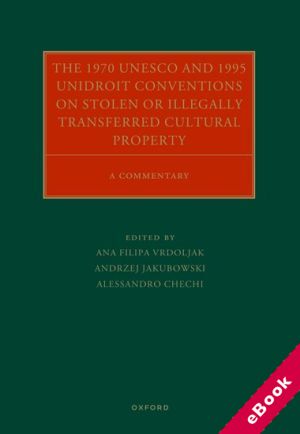
Authored by leading scholars and practitioners from around the world, this Commentary is the first to cover the two leading multilateral treaties on movable cultural heritage in one volume: the Convention on the Means of Prohibiting and Preventing the Illicit Import, Export and Transfer of Ownership of Cultural Property adopted by UNESCO in 1970 and the Convention on Stolen or Illegally Exported Cultural Property adopted by UNIDROIT in 1995.
This Commentary is designed to be the authoritative text for academics, lawyers, policymakers, and diplomats on the protection and regulation of cultural objects. Encompassing both public and private international law rules on the trade in cultural objects, it provides a detailed historical and thematic overview. Drawing on the travaux preparatoires and intergovernmental and state practice over the last half century, the Commentary provides an article-by-article analysis of the interpretation and application of these treaties. The 1970 UNESCO and 1995 UNIDROIT Conventions are examined in the working context of other culture conventions including the World Heritage Convention and the Intangible Heritage Convention, as well as related fields of international law, such as international humanitarian law, international criminal law, human rights law, and international economic law. The volume also offers a critical examination of current trends and future directions which are informing the field.