The eBooks we sell are sold as a single-user licence and are intended for the end user only.
The sale of some eBooks are restricted to certain countries. To alert you to such restrictions, please select the country of the billing address of your credit or debit card you wish to use for payment.
For further information see https://www.wildy.com/ebook-formats
Once the order is confirmed an e-mail will be sent to you to allow you to download the eBook. For UK purchases this will be automatic. For purchases outside the UK a member of staff will need to confirm the sale. (Staff are available to do this during normal business hours, Mon-Fri 8:30-17:00 UK time)
All eBooks are supplied firm sale and cannot be returned. If you believe there is a fault with your eBook then contact us on ebooks@wildy.com and we will help in resolving the issue. This does not affect your statutory rights.
Due to a technical issue some ebooks are not available to order.
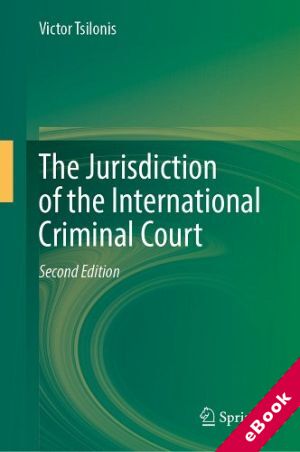
This book embarks on a comprehensive exploration of the jurisdiction of the International Criminal Court (ICC) and elucidates the three foundational aspects of its jurisdiction as laid out in the Rome Statute: the preconditions for exercising jurisdiction (Article 12 ICCRSt), its substantive competence regarding core crimes (Articles 5-8bis ICCRSt), and the principle of complementarity (Article 17§1(a) ICCRSt).
This principle, crucial to understanding the ICC’s ‘ultimate jurisdiction’, is invoked only when a State Party demonstrates an inability or unwillingness to genuinely undertake investigation or prosecution. The book further probes the ‘negative preconditions’ of the Court’s jurisdiction, in particular, immunities (Article 27 ICCRSt) and exceptions through Security Council referrals (Articles 13(b) and 15 ICCRSt).
Intended for students, scholars, and practitioners alike, this second edition offers invaluable insights into the ICC’s jurisdiction, making a notable contribution to the existing literature. Importantly, it also navigates emerging fields of international criminal law, addressing topical and thought-provoking subjects such as ecocide, cyber warfare, automated lethal weapons, artificial intelligence, and the legal complexities arising from the Russian invasion of Ukraine.