The eBooks we sell are sold as a single-user licence and are intended for the end user only.
The sale of some eBooks are restricted to certain countries. To alert you to such restrictions, please select the country of the billing address of your credit or debit card you wish to use for payment.
For further information see https://www.wildy.com/ebook-formats
Once the order is confirmed an e-mail will be sent to you to allow you to download the eBook. For UK purchases this will be automatic. For purchases outside the UK a member of staff will need to confirm the sale. (Staff are available to do this during normal business hours, Mon-Fri 8:30-17:00 UK time)
All eBooks are supplied firm sale and cannot be returned. If you believe there is a fault with your eBook then contact us on ebooks@wildy.com and we will help in resolving the issue. This does not affect your statutory rights.
Due to a technical issue some ebooks are not available to order.
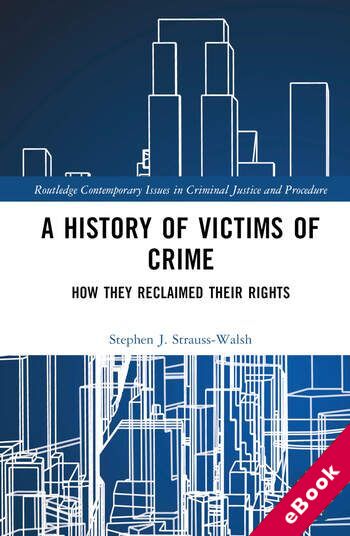
This book examines the evolution of the contemporary crime victim’s procedural place within modern western societies. Taking the history of the Irish crime victim as a case study, the work charts the place of victims within criminal justice over time. This evolves from the expansive latitude that they had during the eighteenth century, to their major relegation to witness and informer in the nineteenth, and back to a more contemporary recapturing of some of their previous centrality. The book also studies what this has meant for the position of suspects and offenders as well as the population more generally. Therefore, some analysis is devoted to examining its impact on an offender’s right to fair trial and social forms. It is held that the modern crime victim has transcended its position of marginality. This happened not only in law, but as the consequence of the victim’s new role as a key socio-political stakeholder. This work flags the importance of victim rights conferrals, and the social transformations that engendered such trends. In this way victim re-emergence is evidenced as being not just a legal change, but a consequence of several more recent socio-cultural transformations in our societies. The book will be of interest to researchers, academics and policy makers in criminal law, human rights law, criminology and legal history.