
The eBooks we sell are sold as a single-user licence and are intended for the end user only.
The sale of some eBooks are restricted to certain countries. To alert you to such restrictions, please select the country of the billing address of your credit or debit card you wish to use for payment.
For further information see https://www.wildy.com/ebook-formats
Once the order is confirmed an e-mail will be sent to you to allow you to download the eBook. For UK purchases this will be automatic. For purchases outside the UK a member of staff will need to confirm the sale. (Staff are available to do this during normal business hours, Mon-Fri 8:30-17:00 UK time)
All eBooks are supplied firm sale and cannot be returned. If you believe there is a fault with your eBook then contact us on ebooks@wildy.com and we will help in resolving the issue. This does not affect your statutory rights.
Due to a technical issue some ebooks are not available to order.
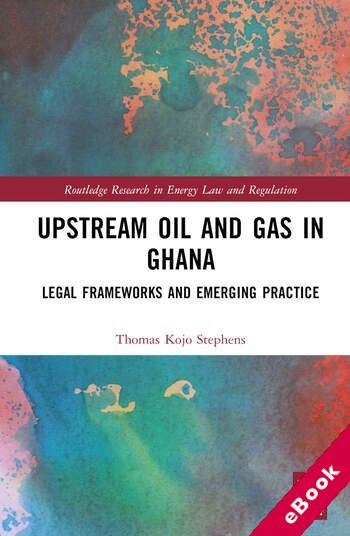
This book explores the myriad issues that play out in the upstream petroleum industry of Ghana from a legal perspective.
Focusing on Ghana as an emerging petroleum country, Thomas Kojo Stephens begins by examining whether the existing constitutional framework will be effective in governing the expanding oil and gas sector. Drawing on various approaches proffered by other experts in the field, Stephens looks at possible institutional structures that could be put in place and juxtaposes these ideas with the experience of Ghana to test the efficacy of these proposals. He also explores the types of contractual frameworks currently implemented in Ghana for comparison with other emerging petroleum economies, examining the barriers to effectiveness, novel provisions that must be incorporated and lessons learned from other regions. Finally, the book highlights how vital it is for the Ghanaian State to monitor the use of petroleum revenue and make ethical investment decisions that prioritise the interests of Ghanaian citizens.
Upstream Oil and Gas in Ghana will be of great interest to students and scholars of energy law and policy, oil and gas management and African Studies more broadly, as well as those working in the upstream petroleum industry.










