The eBooks we sell are sold as a single-user licence and are intended for the end user only.
The sale of some eBooks are restricted to certain countries. To alert you to such restrictions, please select the country of the billing address of your credit or debit card you wish to use for payment.
For further information see https://www.wildy.com/ebook-formats
Once the order is confirmed an e-mail will be sent to you to allow you to download the eBook. For UK purchases this will be automatic. For purchases outside the UK a member of staff will need to confirm the sale. (Staff are available to do this during normal business hours, Mon-Fri 8:30-17:00 UK time)
All eBooks are supplied firm sale and cannot be returned. If you believe there is a fault with your eBook then contact us on ebooks@wildy.com and we will help in resolving the issue. This does not affect your statutory rights.
Due to a technical issue some ebooks are not available to order.
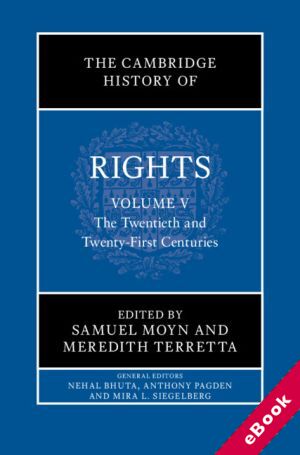
The concept of a right, and the idea of human rights, were familiar abstractions on the brink of the twentieth century. But the history of political mobilization since shows that human rights had a transformative capacity in that century that no prior age had demonstrated. Through the twentieth century, human rights became institutionalized internationally in laws, movements, and organizations that transcended state-based citizenship and governance – which irrevocably changed the politics around them. Rights continued to evolve as the imperial world order transitioned to a postcolonial world of sovereign states as a primary form of political organization.
Through twenty-six essays from experts around the world demonstrating how this period is historically distinctive, volume five of The Cambridge History of Rights is a comprehensive and authoritative reference for the history of rights in the twentieth and twenty-first centuries.