Wildy Logo
(020) 7242 5778
enquiries@wildy.com

Planning Law:
A Practitioner's
Handbook 2nd ed


 William Webster, Robert Weatherley


Welcome to Wildys

Watch


Corporate Insolvency Practice:
Litigation, Procedure
and Precedents 3rd ed


 Mark Watson-Gandy


Offers for Newly Called Barristers & Students

Special Discounts for Newly Called & Students

Read More ...


Secondhand & Out of Print

Browse Secondhand Online

Read More...


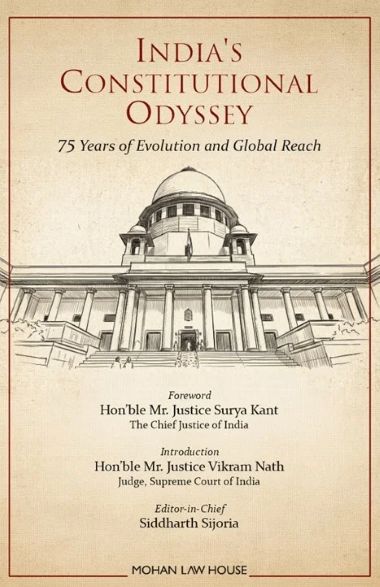
India's Constitutional Odyssey: 75 Years of Evolution and Global Reach

Edited by: Siddharth Sijoria

ISBN13: 9788199209800
Published: June 2026
Publisher: Mohan Law House
Country of Publication: India
Format: Hardback
Price: £45.00


Despatched in 7 to 9 days.

The completion of seventy-five years of the Constitution of India invites reflection as much as celebration. Adopted in 1950, the Constitution governs the world’s largest democracy and stands as one of the most enduring and dynamic constitutional charters of the modern era. It has survived political transitions, ideological contestations, numerous constitutional amendments, and the severe constitutional disruption of the Emergency. Despite sustained pressures—at times testing its institutional and moral foundations—it has neither fractured nor stagnated. Instead, it has adapted, evolved, and deepened its normative commitments.

A substantial part of this evolution has been shaped by the interpretive role of the Supreme Court of India. Through creative yet principled constitutional interpretation, the Court has transformed a detailed constitutional text into a living and responsive instrument. The articulation of the Basic Structure doctrine, the expansion of fundamental rights jurisprudence, the development of public interest litigation, and the elaboration of constitutional morality and the substantive rule of law have together forged a distinctive Indian constitutional identity. What began as a Constitution influenced by comparative models has, over time, itself become a source of persuasive authority in constitutional adjudication beyond India’s borders.

This book is intended to serve as a resource for academicians, judges, lawyers, and students of comparative constitutional law who seek to understand both the internal development and the external influence of Indian constitutional jurisprudence. By bringing together diverse voices and jurisdictions, it aims to document not only doctrinal influence, but also the continuing dialogue that sustains comparative constitutionalism.

Subjects:
Constitutional and Administrative Law, Other Jurisdictions , India
Contents:
Foreword
Introduction
Message from the Chief Justice of the Kingdom of Tonga
Message from Law Commissioner UK
Message from President of the Commonwealth Lawyers Association
Editorial Note
Acknowledgement
India’s Republican Leap: A Choice that Changed the Commonwealth - Professor Luis G Franceschi
The Osmotic Percolation of Indian Constitutionalism Across The Palk Strait - Justice A.H.M.D. Nawaz
From New Delhi to Accra: Reflections on the Influence of India’s Constitutional Jurisprudence in Ghana’s Constitutional Adjudication - Justice Nene A.O. Amegatcher
Comparative Constitutionalism in Practice: Indian Supreme Court Influence on Kenyan Adjudication - Justice David Mwangi Mugo, David M. Chege & Nelson M. Mugo
Comparative Jurisprudence and the Role of Indian Constitutional Jurisprudence in Zimbabwean Law - Ms. Vimbai Nyemba
“Basic Structure, UCA, European Case-Law and the Venice Commission - Dr. Schnutz Rudolf Dürr
Judicial Tests of Free Speech in India and Malaysia: Explaining India’s More Liberal Constitutional Approach - Steven Thiru & Phoebe Yeoh Pae Lii
The Constitution of India in the English-speaking Caribbean – An Enduring Influence - Rupert Wheeler
Seventy-Five Years of the Indian Constitution: Its Enduring Influence on Guyanese Constitutional Law – A Human Rights Perspective - Sydney Fraser
Unamendable Constitutional Essentials: India’s Basic Structure Doctrine in Commonwealth Constitutionalism - Siddharth Sijoria
The Resilient Republic of India - Dr. Vikas Singh
Legitimacy, Legalism, and the Indian Republic: A lasting Legacy for the International Community - Mohan V. Katarki
The Basic Structure Doctrine as a Guarantee of Normative Unity in the Analysis and Interpretation of Constitutional form and Content - Ainhoa Lasa López
Artwork Embedded Indian Constitution - Vijay Hansaria
Constitutional Morality and the Rule of Law: India’s Post-Colonial Transformation and Its Commonwealth Resonance - Mr. R. Santhanam Krishnan & Keshav Kumar Ishwar
Contribution of the Parsi Community in Framing and Defending the Constitution of India - Shayan J. Bisney
Basics of the Evolution of the Law on Mandamus in India as a Common Law Remedy for Public Wrong - J.P. Cama & Nitish Raj
The Power of the Pen: Judicial Review, Rule of Law, and the Constitutional Discipline of State Power - Aruneshwar Gupta
Freedom of Speech and Expression under the Constitution: Indian Constitutional Doctrine and Comparative Perspectives - Hon’ble Mr. Justice J.J. Munir
Critical Imperatives for the Better Working of Our Constitution - V. Sudhish Pai
Unlocking Rights: Self-Incrimination and Privacy in the Smartphone Era - Ankur Mody
Technology, Surveillance, and the Right to Privacy: Constitutional Responses in the Digital Age - Jatinder (Jay) Cheema Esq.
Reimagining Justice: Article 32 and the Development of Public Interest Litigation in India - Dr. Swapnil Tripathi
India’s Constitutional Experiment with Affirmative Action - Dr. Anurag Bhaskar
Parliamentary Autonomy and Models of Representative Democracy: British, Indian, and Commonwealth Perspectives - Maximilian Taylor
India’s Anti-Defection Law – Locating the Devil in the Detail - Ritwika Sharma & Mayuri Gupta
A Living Constitution for a Living Planet: Environmental Constitutionalism in the Indian Supreme Court - Melinda Janki
The Reach of the Indian Constitution into Community Rights and Natural Resource Conflicts - Dwight Newman
The Sui Generis Separation of Powers under The Indian Constitution: Judicial Review and Institutional
Accountability - Utkarsh Kumar Sonkar
Constitutional Secularism in India and the Commonwealth: Managing Pluralism in Divided Societies - Rucha Raut
Beyond Mutual Exclusivity: Navigating Article 32 in a Federal Scheme - Dr. Anindita Pujari & Shaileshwar Yadav
Afterword