
The eBooks we sell are sold as a single-user licence and are intended for the end user only.
The sale of some eBooks are restricted to certain countries. To alert you to such restrictions, please select the country of the billing address of your credit or debit card you wish to use for payment.
For further information see https://www.wildy.com/ebook-formats
Once the order is confirmed an e-mail will be sent to you to allow you to download the eBook. For UK purchases this will be automatic. For purchases outside the UK a member of staff will need to confirm the sale. (Staff are available to do this during normal business hours, Mon-Fri 8:30-17:00 UK time)
All eBooks are supplied firm sale and cannot be returned. If you believe there is a fault with your eBook then contact us on ebooks@wildy.com and we will help in resolving the issue. This does not affect your statutory rights.
Due to a technical issue some ebooks are not available to order.
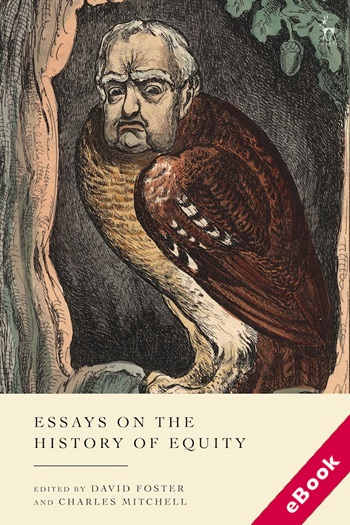
This volume presents various facets of the history of equity in England between the 14th and 20th centuries.
Writing a history (or histories) of equity automatically raises difficult questions of philosophy and theology, as well as jurisprudence and legal history. When one speaks of 'equity', for example, do we mean Aristotelian epieikeia, civilian aequitas, a theological/juridical conscience, the common law concept of the 'equity of the statute', or merely the rules applied by the court of chancery before 1875?
This terminological problem is compounded when we consider how these ideas were developed over time. Whilst conscience had been an organising concept for St German, the political disputes surrounding the Earl of Oxford's case introduced the prerogative into contemporary understandings of the chancery's jurisdiction. The emergence of clear, doctrinal rules governing (inter alia) the equity of redemption and the beneficiary's right under a trust may well be attributable to the complex interplay of theory and practice in the central courts of equity at this time.
If the earlier history of equity remains somewhat obscure, the same is no less true of developments in the 18th, 19th, and 20th centuries. Whereas the historian of the 14th century might search in vain for new material, the modern era poses the opposite problem. The overwhelming glut of undigested information in the later period – treatises, court records, reports, pamphlets, practice manuals – raises obvious issues of source selection when generating new narratives for the period.
Whether by investigating the historical foundations of the modern law, the jurisprudential underpinnings of the equitable jurisdiction, or the socio-political context of discrete legal developments, this collection of essays exposes the strands of thought which 'equity' comprises and the mechanisms by which its rules evolved. In so doing, this collection provides a useful way-marker for future studies in the nature and history of English equity.










