The eBooks we sell are sold as a single-user licence and are intended for the end user only.
The sale of some eBooks are restricted to certain countries. To alert you to such restrictions, please select the country of the billing address of your credit or debit card you wish to use for payment.
For further information see https://www.wildy.com/ebook-formats
Once the order is confirmed an e-mail will be sent to you to allow you to download the eBook. For UK purchases this will be automatic. For purchases outside the UK a member of staff will need to confirm the sale. (Staff are available to do this during normal business hours, Mon-Fri 8:30-17:00 UK time)
All eBooks are supplied firm sale and cannot be returned. If you believe there is a fault with your eBook then contact us on ebooks@wildy.com and we will help in resolving the issue. This does not affect your statutory rights.
Due to a technical issue some ebooks are not available to order.
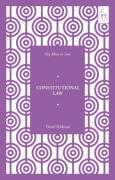
This book argues that disagreement lies at the heart of all constitutions - particularly the UK's - and that efforts to manage it drive constitutional change.
Disagreements are the lifeblood of democratic politics. Constitutions try to provide a framework of authoritative practices and ground rules within which disagreements (including challenges to constitutional distributions of powers and their use) can be managed without making government unworkable. This book shows how conflicts are managed in the UK's constitution, and how institutions and officials may work together even when their roles and values diverge.
Constitutions and constitutional law sometimes seem to be collections of rules, institutions and practices, or expressions of consensus concerning political values. But there are tensions over allocation and use of powers, and a constitution's dynamic character is largely a result of attempts to keep them under control, however strongly people disagree. Constitutions require a degree of stability and cooperation, but must also respond to social, economic, military and political exigencies, and also to changes in people's expectations of the state and beliefs about what makes it legitimate. To illuminate these multifarious aspirations and forces, the book examines how constitutions grow from disagreement and power relations, before looking at how different kinds of power are allocated between state institutions at different levels of government, how they are distributed between institutions at the same level of government, and some of the values which animate the relationships between institutions.
While focusing primarily on the UK, the book uses examples from many constitutional systems to help readers to understand not only what constitutional rules are, but also how systems help to sustain states' orderly political and legal activities. The book will be useful for people embarking on the study of law, politics or government, and will be of interest to more established practitioners and scholars.





Due to a technical issue some ebooks are not available to order.

Due to a technical issue some ebooks are not available to order.
Due to a technical issue some ebooks are not available to order.

Due to a technical issue some ebooks are not available to order.

Due to a technical issue some ebooks are not available to order.

Due to a technical issue some ebooks are not available to order.