
The eBooks we sell are sold as a single-user licence and are intended for the end user only.
The sale of some eBooks are restricted to certain countries. To alert you to such restrictions, please select the country of the billing address of your credit or debit card you wish to use for payment.
For further information see https://www.wildy.com/ebook-formats
Once the order is confirmed an e-mail will be sent to you to allow you to download the eBook. For UK purchases this will be automatic. For purchases outside the UK a member of staff will need to confirm the sale. (Staff are available to do this during normal business hours, Mon-Fri 8:30-17:00 UK time)
All eBooks are supplied firm sale and cannot be returned. If you believe there is a fault with your eBook then contact us on ebooks@wildy.com and we will help in resolving the issue. This does not affect your statutory rights.
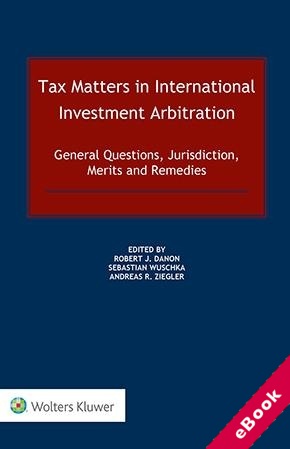
In recent years, tax-related matters in investment treaty arbitration have received prominent attention. Following the 2020 award in Cairn Energy v. India, investment treaty cases involving an alleged violation of investors’ rights in taxation matters continue to be on the uprise. Therefore, arbitral tribunals are increasingly required to interpret tax carve-outs and to give content to investment treaty protection standards in a tax-related context. Further, the interaction between these standards and those shaping the international tax system has begun to surface in arbitral awards. At the policy level, the recent evolution has been equally intense. On the one hand, sophisticated tax carve-outs and filter mechanisms (sometimes with cross-references to the principles of the international tax system) continue to be included in investment agreements. On the other hand, the relation between investment arbitration and taxation matters has been a recent focus of the work of the UN Committee of Experts on International Cooperation in Tax Matters.
This book, which comprises 18 chapters written by distinguished authors of the international tax and investment law communities, brings together comprehensive in-depth research and practical guidance as well as policy recommendations on all aspects involving taxation matters in investment arbitration. The book also contains two introductory chapters presenting the latest evolution of the international tax system and the investment treaty regime. The chapters of the book explore notably the following issues and topics:
The book is intended to serve as a comprehensive reference tool to those engaged in investment treaty disputes involving taxation matters. Moreover, the volume also aims at stimulating the discussion at the policy and scholarly level with respect to the coordination between the investment treaty regime and the international tax system.










