The eBooks we sell are sold as a single-user licence and are intended for the end user only.
The sale of some eBooks are restricted to certain countries. To alert you to such restrictions, please select the country of the billing address of your credit or debit card you wish to use for payment.
For further information see https://www.wildy.com/ebook-formats
Once the order is confirmed an e-mail will be sent to you to allow you to download the eBook. For UK purchases this will be automatic. For purchases outside the UK a member of staff will need to confirm the sale. (Staff are available to do this during normal business hours, Mon-Fri 8:30-17:00 UK time)
All eBooks are supplied firm sale and cannot be returned. If you believe there is a fault with your eBook then contact us on ebooks@wildy.com and we will help in resolving the issue. This does not affect your statutory rights.
Due to a technical issue some ebooks are not available to order.
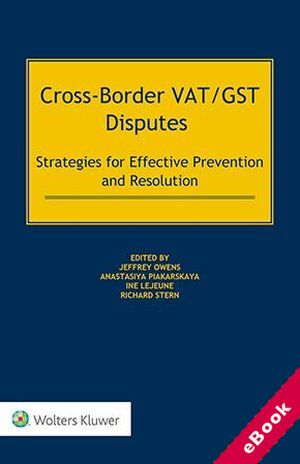
Cross-Border VAT/GST Disputes: Strategies for Effective Prevention and Resolution is a book that examines recent and ongoing cross-border VAT/GST disputes in both EU and non-EU countries, investigates the causes of these disputes, analyzes the dispute mitigation opportunities provided by existing mechanisms, and explores the potential for leveraging new mechanisms. The distinguished contributors to this volume address these challenges by, for the first time, developing a set of practical, cost-effective policy options in the area of cross-border VAT/GST dispute prevention and resolution.
What’s in this book:
This work offers a structured and practical toolbox for tax policymakers, tax administrations, dispute resolution bodies and businesses. Inspired by the OECD and the EU work and drawing on the experiences of EU and non-EU countries, it outlines actionable strategies to strengthen cross-border VAT/GST dispute prevention and resolution. The authors examine the following topics:
The contributions draw on data collected through surveys administered by the Global Tax Policy Center at the Institute for Austrian and International Tax Law, Vienna University of Economics and Business, along with input from members of the Multistakeholder Group and Working Groups of the WU GTPC Project on cross-border VAT/GST disputes—including representatives from business, tax administrations, dispute resolution bodies, international and regional organizations, and academia—on their experiences and perspectives on strengthening the international system for minimizing and resolving cross-border VAT/GST disputes.
How this will help you:
Together, these contributions provide a unique and valuable foundation for identifying the most adaptive and harmonized ways to prevent and resolve cross-border VAT/GST disputes at domestic and international levels. Ultimately, the recommendations aim to contribute to more competitive national, regional and global fiscal systems and to foster a more transparent, cooperative, and trustworthy international tax environment, providing greater certainty to the unpaid VAT/GST collectors, the business and the tax authorities.