The eBooks we sell are sold as a single-user licence and are intended for the end user only.
The sale of some eBooks are restricted to certain countries. To alert you to such restrictions, please select the country of the billing address of your credit or debit card you wish to use for payment.
For further information see https://www.wildy.com/ebook-formats
Once the order is confirmed an e-mail will be sent to you to allow you to download the eBook. For UK purchases this will be automatic. For purchases outside the UK a member of staff will need to confirm the sale. (Staff are available to do this during normal business hours, Mon-Fri 8:30-17:00 UK time)
All eBooks are supplied firm sale and cannot be returned. If you believe there is a fault with your eBook then contact us on ebooks@wildy.com and we will help in resolving the issue. This does not affect your statutory rights.
Due to a technical issue some ebooks are not available to order.
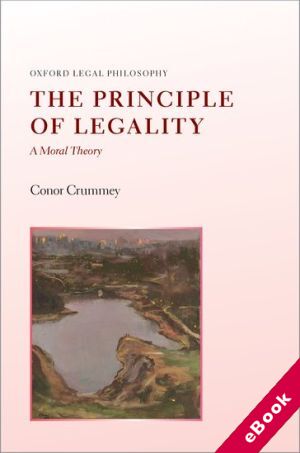
It is a well-known tenet of public law that judges must interpret a statute consistently with common law rights and principles, unless that statute uses 'clear and express' language to license their violation of such rights and principles. This is the 'principle of legality'. But what rights and principles activate this rule of statutory construction? How explicit must statutory language be to permit the violation of common law rights? Is there a point at which a potential interference with common law principles is so egregious that even a clearly-worded statute cannot license it?
The Principle of Legality: A Moral Theory develops a theory to help us engage with and answer these questions. Professor Conor Crummey challenges prevailing accounts of the principle of legality as a presumption about the intentions of the legislature. By engaging with debates in the philosophy of language and general jurisprudence, the book reveals the shortcomings of these existing theories.
Through the lens of a non-positivist theory of general jurisprudence, The Principle of Legality demonstrates that judges, when invoking the principle of legality, are engaging in a complex process of moral reasoning. This innovative approach provides clear, satisfying answers to some of the most pressing and controversial questions in contemporary public law scholarship.



Due to a technical issue some ebooks are not available to order.

Due to a technical issue some ebooks are not available to order.
Due to a technical issue some ebooks are not available to order.





Due to a technical issue some ebooks are not available to order.
Due to a technical issue some ebooks are not available to order.

Due to a technical issue some ebooks are not available to order.

Due to a technical issue some ebooks are not available to order.

Due to a technical issue some ebooks are not available to order.
Due to a technical issue some ebooks are not available to order.

Due to a technical issue some ebooks are not available to order.