The eBooks we sell are sold as a single-user licence and are intended for the end user only.
The sale of some eBooks are restricted to certain countries. To alert you to such restrictions, please select the country of the billing address of your credit or debit card you wish to use for payment.
For further information see https://www.wildy.com/ebook-formats
Once the order is confirmed an e-mail will be sent to you to allow you to download the eBook. For UK purchases this will be automatic. For purchases outside the UK a member of staff will need to confirm the sale. (Staff are available to do this during normal business hours, Mon-Fri 8:30-17:00 UK time)
All eBooks are supplied firm sale and cannot be returned. If you believe there is a fault with your eBook then contact us on ebooks@wildy.com and we will help in resolving the issue. This does not affect your statutory rights.
Due to a technical issue some ebooks are not available to order.
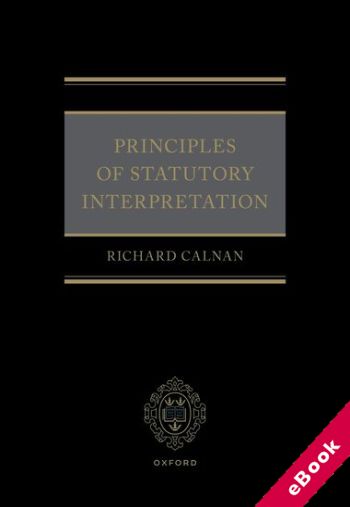
The interpretation of legal texts is, essentially, a question of judgement. But that judgement cannot be exercised arbitrarily, it must be exercised in accordance with the rule of law. In Principles of Statutory Interpretation, Richard Calnan explains these rules using seven defined principles that should be considered when interpreting legislation.
The first principle of 'object intention' concerns establishing how a reasonable person would interpret the legislation. The second confirms that the actual text or words of the statute are the source of that objective intention. Principle 3 reminds us that words used must be interpreted given their role in the statute as a whole, and the fourth principle examines how that context may be judged. The fifth and sixth highlight that words should, generally, be given their natural meaning in statute, and for those words that are ambiguous, the approach is to apply the meaning that the legislature is most likely to have intended. However, the seventh principle recognises that there are circumstances when words are given a meaning which differs from their natural meaning.
These principles are not a series of self-contained precepts which can be applied independently of each other, rather they need to be understood together. Principles of Statutory Interpretation, provides the reader with examples which illustrate how the various principles of statutory interpretation, work in practice.