Wildy Logo
(020) 7242 5778
enquiries@wildy.com

Book of the Month

Cover of Constitutional Agency

Constitutional Agency

Price: £105.00

Planning Law:
A Practitioner's
Handbook 2nd ed


 William Webster, Robert Weatherley


Welcome to Wildys

Watch


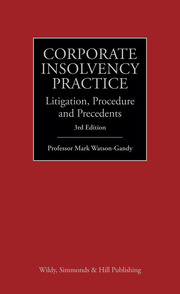
Corporate Insolvency Practice:
Litigation, Procedure
and Precedents 3rd ed


 Mark Watson-Gandy


Offers for Newly Called Barristers & Students

Special Discounts for Newly Called & Students

Read More ...


Secondhand & Out of Print

Browse Secondhand Online

Read More...


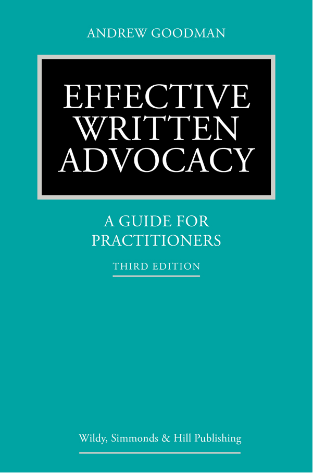
Effective Written Advocacy: A Guide for Practitioners 3rd


ISBN13: 9780854903177
Previous Edition ISBN: 9780854900954
To be Published: January 2027
Publisher: Wildy, Simmonds and Hill Publishing
Country of Publication: UK
Format: Paperback
Price: £49.00


Is it possible to win your case before arriving at court? The author, a practitioner for over forty years, believes a highly focused approach to your written advocacy – pre-litigation correspondence, written negotiation, Part 36 offers, statements of case and skeleton arguments, written opening notes for trial, closing submissions and costs submissions – will put you in the best possible position to do just that.

The importance of oral advocacy in deciding cases is not in dispute, but increasingly judges form pre-trial opinions of the likely outcome from written material, notably the skeleton or opening note. The application, trial or appeal then becomes a process to measure the judge’s pre-formed view. The effective written closing submission will become part of the judgment.

This third edition not only offers a practical and comprehensive guide to effective written advocacy but provides 16 new worked examples drawn from real cases contributed from leading advocates such as Grahame Aldous KC, Neil Block KC, Michael Kallipetis KC, Richard Lissack KC, and Lord Pannick KC. It also contains new chapters on statements of case as written advocacy, and on the use of AI for research and the production of documents.

Invaluable to the practising lawyer and student alike, this book will also be compelling reading for anyone with an interest in using the legal process.
Subjects:
Advocacy, Drafting and Legal Writing, Wildy, Simmonds and Hill, Courts and Procedure
Contents:
Foreword and Acknowledgements
Foreword to the First Edition
Table of Cases

PART 1 – SKELETON ARGUMENTS AND WRITTEN
SUBMISSIONS

What the Court Requires
King’s Bench Division
Business and Property Division
Admiralty, Commercial and Mercantile Courts
The Technology and Construction Court
Arbitration
The Patent Court
The Administrative Court
Reference to skeleton arguments for specialist proceedings
in the civil courts
The county court
Family proceedings
Criminal proceedings
The Court of Appeal
Cases for the Supreme Court

2. What Judges Want
Immediate and future use
What do judges want?
The trial and appellate judge
Directions
Length
Overall visual impression
Citation
Footnotes
Headings
Summaries
Repetition
Abbreviations
Textual enhancement
Structure of the argument
Getting it wrong

PART 2 – DEVELOPING WRITTEN ADVOCACY SKILLS

3. Skills for the Practitioner

4. Creating a Style for Written Advocacy
Organising your thoughts
The practical process
Suggestions for writing
The Wiener essentials
And some negative suggestions

5. Literary Techniques for the Advocate
English usage
A literary style for lawyers
Document design
Headings
Cross-references
Footnotes
Textual enhancement
Citation

6. The Technique of Persuasion in Writing
Organisation
Using the facts to persuade
Choosing the battle ground
Conveying the issues
Advancing your argument
Using argumentative headings
Marshalling facts in argument
Argument and reasoning
Supporting your argument
The value of candour
Arguments in reply
Matters to avoid
Using a conclusion

7. The Art of Précis for Lawyers
What to do if your document is too long
The précis exercise

8. Tasks before Lodging
Checking for accuracy
Filing
Taking a step back
The clarity test
Impress yourself

PART 3 – STATEMENTS OF CASE AS ADVERSARIAL DOCUMENTS

9. Statements of Case as Adversarial Documents
Drafting statements of case
The impact of the statement of truth
Alternative or inconsistent statements of fact

PART 4 – THE USE OF AI IN WRITTEN ADVOCACY

10. The Use of AI in Written Advocacy
Anthropomorphosis

PART 5 – WHAT SUCCESSFUL ADVOCATES PROVIDE:
WORKED EXAMPLES
br
11. Introduction to Worked Examples
Visual advocacy at trial
Worked examples
The tribunal in question
Examples A-P

12. Conclusion: Fifteen Key Points to Writing a Successful
Skeleton

PART 6 – WRITTEN ADVOCACY OUTSIDE THE COURTS

13. Inter-partes Correspondence: The ‘Dear Judge’ Letter

14. Pre-action Protocol Letters of Claim and Reply

15. Part 36 Offers

16. Introduction to Worked Examples
Example Q
Example R
Example S
Example T
Example U

17. Conclusion
Books
Articles
Lectures

Index