The eBooks we sell are sold as a single-user licence and are intended for the end user only.
The sale of some eBooks are restricted to certain countries. To alert you to such restrictions, please select the country of the billing address of your credit or debit card you wish to use for payment.
For further information see https://www.wildy.com/ebook-formats
Once the order is confirmed an e-mail will be sent to you to allow you to download the eBook. For UK purchases this will be automatic. For purchases outside the UK a member of staff will need to confirm the sale. (Staff are available to do this during normal business hours, Mon-Fri 8:30-17:00 UK time)
All eBooks are supplied firm sale and cannot be returned. If you believe there is a fault with your eBook then contact us on ebooks@wildy.com and we will help in resolving the issue. This does not affect your statutory rights.
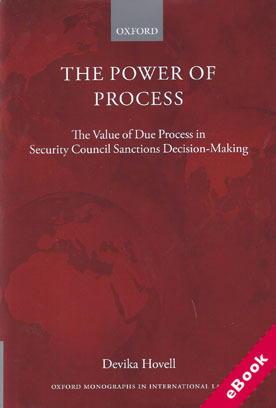
The UN Security Council's transition to 'targeted sanctions' in the 1990s marked a revolutionary shift in the locus of the Council's decision-making from states to individuals.
The establishment of the targeted sanctions regime, rather than a change in policy, invites attention to an emerging tier of international governance. A shift in policy engineered to inject greater fairness into the sanctions regime has subsequently given rise to more than a decade of debate about the lack of due process in sanctions decision-making.
This book examines the need to develop a due process framework having regard to the uniquely political and crisis-based context in which the Security Council operates. In response to questions raised on how the UN Security Council didn't considered the need to give due process to individuals impacted directly by its decisions. Through this controversy in the sanctions context was created, where individuals have been subject to global asset freezes, travel bans and employment bans, described as a form of 'civic death'.
Drawing on Anglo-American jurisprudence, this book develops procedural principles for the international institutional context using a value-based approach as an alternative to the formalistic approach taken in the literature to date. In doing so, it is recognized that due process is more than a set of discrete legal standards, but is a touchstone for the way the international legal order conceives of far larger questions about community, law and values.