The eBooks we sell are sold as a single-user licence and are intended for the end user only.
The sale of some eBooks are restricted to certain countries. To alert you to such restrictions, please select the country of the billing address of your credit or debit card you wish to use for payment.
For further information see https://www.wildy.com/ebook-formats
Once the order is confirmed an e-mail will be sent to you to allow you to download the eBook. For UK purchases this will be automatic. For purchases outside the UK a member of staff will need to confirm the sale. (Staff are available to do this during normal business hours, Mon-Fri 8:30-17:00 UK time)
All eBooks are supplied firm sale and cannot be returned. If you believe there is a fault with your eBook then contact us on ebooks@wildy.com and we will help in resolving the issue. This does not affect your statutory rights.
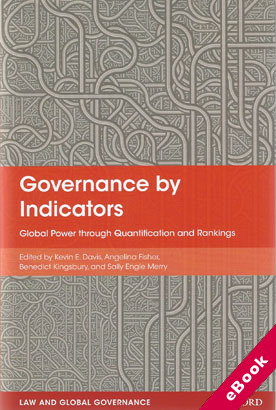
The use of indicators as a technique of global governance is increasing rapidly. Major examples include the World Bank's Doing Business Indicators, the World Bank's Good Governance and Rule of Law indicators, the Millennium Development Goals, and the indicators produced by Transparency International. Human rights indicators are being developed in the UN and regional and advocacy organizations.
The burgeoning production and use of indicators has not, however, been accompanied by systematic comparative study of, or reflection on, the implications, possibilities, and pitfalls of this practice.
This book furthers the study of these issues by examining the production and history of indicators, as well as relationships between the producers, users, subjects, and audiences of indicators. It also explores the creation, use, and effects of indicators as forms of knowledge and as mechanisms of making and implementing decisions in global governance. Using insights from case studies, empirical work, and theoretical approaches from several disciplines, the book identifies legal, policy, and normative implications of the production and use of indicators as a tool of global governance.