The eBooks we sell are sold as a single-user licence and are intended for the end user only.
The sale of some eBooks are restricted to certain countries. To alert you to such restrictions, please select the country of the billing address of your credit or debit card you wish to use for payment.
For further information see https://www.wildy.com/ebook-formats
Once the order is confirmed an e-mail will be sent to you to allow you to download the eBook. For UK purchases this will be automatic. For purchases outside the UK a member of staff will need to confirm the sale. (Staff are available to do this during normal business hours, Mon-Fri 8:30-17:00 UK time)
All eBooks are supplied firm sale and cannot be returned. If you believe there is a fault with your eBook then contact us on ebooks@wildy.com and we will help in resolving the issue. This does not affect your statutory rights.
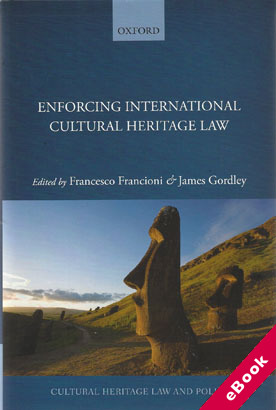
The idea of cultural heritage as an 'international public good' can be traced back to the Preamble of the 1954 Hague Convention for the Protection of Cultural Property in the Event of Armed Conflict, according to which "damage to cultural property belonging to any people whatsoever means damage to the cultural heritage of all mankind".
How this idea of cultural heritage as a global public good can be reconciled with the effective enforcement of protection norms is the subject of this study.
Bringing together world experts in protecting cultural heritage, Enforcing International Cultural Heritage Law examines the different ways that cultural heritage property can be protected, including protection at the international level, enforcement in domestic courts, and the role of alternative dispute resolution mechanisms.
The book is divided into three sections. The first section assesses international law and analyses the interaction between international and domestic norms of public and private law. It discusses the different methods of international enforcement, the role of international and mixed criminal tribunals and courts, and the means for protecting cultural heritage in times of armed conflict.
The second section addresses the role of national courts, discussing such topics as: barriers to domestic enforcement of international norms, the refusal to enforce foreign law, the difficulty of territorial boundaries in relation to underwater heritage, and the application of criminal sanctions by domestic courts.
The final section of the book surveys alternatives to the legal enforcement of the norms protecting cultural heritage, including arbitration, soft law, and diplomacy.