The eBooks we sell are sold as a single-user licence and are intended for the end user only.
The sale of some eBooks are restricted to certain countries. To alert you to such restrictions, please select the country of the billing address of your credit or debit card you wish to use for payment.
For further information see https://www.wildy.com/ebook-formats
Once the order is confirmed an e-mail will be sent to you to allow you to download the eBook. For UK purchases this will be automatic. For purchases outside the UK a member of staff will need to confirm the sale. (Staff are available to do this during normal business hours, Mon-Fri 8:30-17:00 UK time)
All eBooks are supplied firm sale and cannot be returned. If you believe there is a fault with your eBook then contact us on ebooks@wildy.com and we will help in resolving the issue. This does not affect your statutory rights.
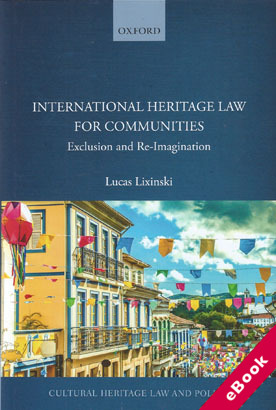
This book critically engages the shortcomings of the field of international heritage law, seen through the lenses of the five major UNESCO treaties for the safeguarding of different types of heritage.
It argues that these five treaties have effectively prevented local communities, who bear the brunt of the costs associated with international heritage protection, from having a say in how their heritage is managed. The exclusion of local communities often alienates them not only from international decision-making processes but also from their cultural heritage itself, ultimately meaning that systems put in place for the protection of cultural heritage contribute to its disappearance in the long term.
International Heritage Law for Communities adds to existing literature by looking at these UNESCO treaties not as isolated regimes, but rather as belonging to a discursive continuum on cultural heritage. In doing so, the book focuses on themes that cut across the relevant UNESCO regimes like the use of expert rule in international heritage law, economics, the relationship between heritage and the environment, among others, rather than the regimes themselves.
It uses this mechanism to highlight the blind spots and unintended consequences of UNESCO treaties and how choices made in their drafting have continuing and potentially negative impacts on how we think about and safeguard heritage.