The eBooks we sell are sold as a single-user licence and are intended for the end user only.
The sale of some eBooks are restricted to certain countries. To alert you to such restrictions, please select the country of the billing address of your credit or debit card you wish to use for payment.
For further information see https://www.wildy.com/ebook-formats
Once the order is confirmed an e-mail will be sent to you to allow you to download the eBook. For UK purchases this will be automatic. For purchases outside the UK a member of staff will need to confirm the sale. (Staff are available to do this during normal business hours, Mon-Fri 8:30-17:00 UK time)
All eBooks are supplied firm sale and cannot be returned. If you believe there is a fault with your eBook then contact us on ebooks@wildy.com and we will help in resolving the issue. This does not affect your statutory rights.
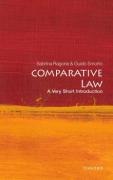
Comparative Law: A Very Short Introduction aims to offer a concise introduction to Comparative Law—its objectives, methods, concepts and uses. After an overview of the fundamental definitions, key concepts and basic lexicon of the discipline, the book proposes an analysis of the most successful techniques adopted in legal comparison for mapping the world's legal systems and for explaining legal change and diffusion of law, also giving a concise description of the legal traditions of the world.
It also offers an account of the competing approaches adopted over time in comparative endeavours, from functionalism to culturalism and postmodernism, and highlights the different emphasis placed by each of these approaches on commonalities, faith in universal law and convergence, or on divergence and irreducible differences. Finally, the book provides readers with an understanding of the practical use of comparative law, describing how legal comparison is employed both in law-making and in adjudication, supplementing legal reasoning and interpretation.