The eBooks we sell are sold as a single-user licence and are intended for the end user only.
The sale of some eBooks are restricted to certain countries. To alert you to such restrictions, please select the country of the billing address of your credit or debit card you wish to use for payment.
For further information see https://www.wildy.com/ebook-formats
Once the order is confirmed an e-mail will be sent to you to allow you to download the eBook. For UK purchases this will be automatic. For purchases outside the UK a member of staff will need to confirm the sale. (Staff are available to do this during normal business hours, Mon-Fri 8:30-17:00 UK time)
All eBooks are supplied firm sale and cannot be returned. If you believe there is a fault with your eBook then contact us on ebooks@wildy.com and we will help in resolving the issue. This does not affect your statutory rights.
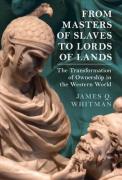
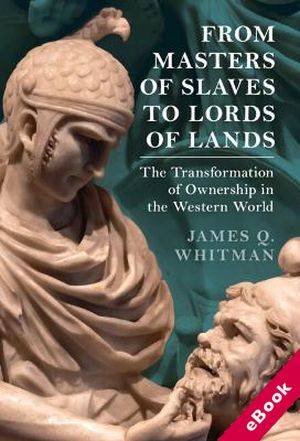
Today we think of land as the paradigmatic example of property, while in the past, the paradigmatic example was often a slave. In this seminal work, James Q. Whitman asserts that there is no natural form of ownership. Whitman dives deep into the long Western history of this transformation in the legal imagination - the transformation from the ownership of humans and other living creatures to the ownership of land. This change extended over many centuries, coming to fruition only on the threshold of the modern era. It brought with it profound changes, not only in the way we understand ownership but also in the way we understand the state. Its most dramatic consequence arrived in the nineteenth century, with the final disappearance of the lawful private ownership of humans, which had been taken for granted for thousands of years.
'A brilliant book with a bold thesis, monstrously erudite, spanning centuries of diverse legal cultures, and written with dazzling clarity and overwhelming authority. This is comparative legal history at its very best.' - Robert W. Gordon, Stanford Law School, and author of Taming the Past: Essays on Law in History and History in Law
'James Whitman presents us with a tremendously valuable and important work, erudite yet accessible, that would interest a wide readership. This study shows why history matters: that property in Western thought had transformed from control over people to control over land matters because it had left us with traces otherwise inexplicable, most particularly, the idea of absolute dominium, and the license to employ violence to obtain, maintain and secure property.' - Tamar Herzog, Monroe Gutman Professor of Latin American Affairs, Harvard University
'Whitman dazzlingly sets out the power of the legal imagination in producing and embedding historical change across the longue duree. He unpeels the palimpsest of property law in this dizzyingly intellectual book. The scholarship is immense, and the implications profound.' - Hannah Skoda, Fellow and Tutor in History, St John's College, Oxford