
The eBooks we sell are sold as a single-user licence and are intended for the end user only.
The sale of some eBooks are restricted to certain countries. To alert you to such restrictions, please select the country of the billing address of your credit or debit card you wish to use for payment.
For further information see https://www.wildy.com/ebook-formats
Once the order is confirmed an e-mail will be sent to you to allow you to download the eBook. For UK purchases this will be automatic. For purchases outside the UK a member of staff will need to confirm the sale. (Staff are available to do this during normal business hours, Mon-Fri 8:30-17:00 UK time)
All eBooks are supplied firm sale and cannot be returned. If you believe there is a fault with your eBook then contact us on ebooks@wildy.com and we will help in resolving the issue. This does not affect your statutory rights.
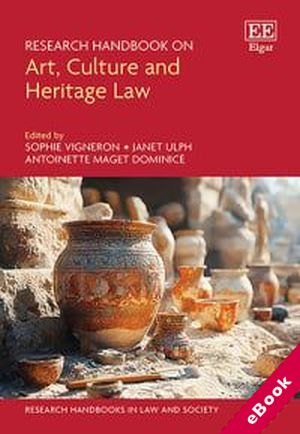
This interdisciplinary Research Handbook brings together leading scholars from different disciplines to explore art, culture and heritage law, their definition, protection and contestation. It critically assesses legal frameworks and ethical practices through four challenges: sustainable development, intergenerational equity, decolonisation and cultural rights.
Adopting both a theoretical and practical approach, contributors debate the key areas in art, culture and heritage law, including the nature of cultural heritage, ethics and the art market, the development of international norms on the protection of cultural heritage, repatriation and its consequences, trafficking in peacetime and the intentional destruction of heritage and looting in wartime. Chapters discuss the significance of provenance research from both legal and ethical perspectives, outlining the changeable nature of heritage objects and the connections they can forge. This Research Handbook ultimately underscores the significance of cross-disciplinary research and public participation in cultural and heritage issues, drawing insights from law, criminology and sociology.
The Research Handbook on Art, Culture and Heritage Law is a valuable resource for scholars and students of law, particularly those interested in the evolution of art and cultural heritage law. It is also a necessary read for those in related fields such as criminology, archaeology, museology and cultural studies.











