
Wildy Logo
(020) 7242 5778
enquiries@wildy.com

Book of the Month

Cover of Toulson & Phipps on Confidentiality

Toulson & Phipps on Confidentiality

Price: £175.00

Advocacy: A Practical
Guide 2nd ed


 Peter Lyons, Chris Taylor


Welcome to Wildys

Watch


Judicial Cooperation in Commercial Litigation 3rd ed (The British Cross-Border Financial Centre World)


 Ian Kawaley, David Doyle, Shade Subair Williams


Offers for Newly Called Barristers & Students

Special Discounts for Newly Called & Students

Read More ...


Secondhand & Out of Print

Browse Secondhand Online

Read More...


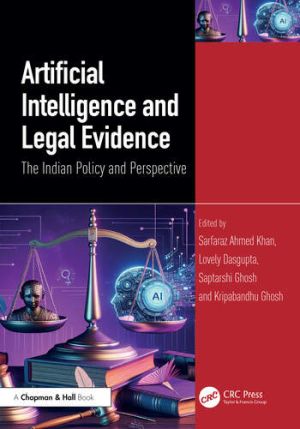
Artificial Intelligence and Legal Evidence: The Indian Policy and Perspective

Edited by: Sarfaraz Ahmed Khan, Lovely Dasgupta, Saptarshi Ghosh, Kripabandhu Ghosh

ISBN13: 9781041046240
To be Published: July 2026
Publisher: Chapman & Hall/CRC
Country of Publication: UK
Format: Hardback
Price: £81.99


This book explores AI’s impact on legal evidence, with a particular focus on its use within Indian law, by identifying the key feature of an Artificial intelligence-driven Justice Delivery System. It seeks to bridge the gap in the literature on the intersection of AI and law, specifically the evaluation of evidence. The book focuses on AI’s potential to enhance the evaluation of evidence in various legal contexts. It considers the reliability, admissibility, and standardisation of AI-generated evidence in legal proceedings.

The key features of the book are:

  • Presents case studies and examples from multiple branches of law, exploring AI’s use in evidence collection, analysis, and evaluation across diverse legal domains
  • Offering a unique perspective on AI and legal evidence within India, the book provides a critical look at how AI can be integrated into India’s legal framework and the implications for the country’s judicial system
  • Addresses the policy gaps and regulatory frameworks needed to govern AI in the legal sphere, with a focus on India's evolving stance on AI
  • Emphasizes the need for ethical standards and privacy protection while using AI to evaluate legal evidence, examines the challenges in ensuring the validity and fairness of AI-generated evidence
  • Highlights the future potential of AI in transforming the legal industry, particularly in terms of improving efficiency, reducing bias, and enabling more effective evidence evaluation

The book will be useful for academicians and scholars interested in Artificial Intelligence’s impact and use in the legal system.


Subjects:
Evidence, IT, Internet and Artificial Intelligence Law
Contents:
Chapter 0. Introduction
Lovely Dasgupta
Chapter 1. Beyond Accuracy: Evaluating LLMs for Evidentiary Use in Legal Contexts Sundaraparipurnan Narayanan, Marie Potel & Vibhav Mithal
Chapter 2. From Paper Trails to Algorithms: AI Impact on Evidence in Law
Ishita Chatterjee
Chapter 3. From Lab Bench to Legal Bench: The Role of AI in Evaluating Biological Evidence Abhisikta Basu & Keya De Mukhopadhyay
Chapter 4. Digital Justice: How Technology Can Transform Evidence in India
Aayana Rai Bhojani & Varun Hemachandran
Chapter 5. RECREATING REALITY: TESTING THE ADMISSIBILITY OF AI-POWERED CYBER CRIME SCENE RECONSTRUCTION
Debdeep Das, Arjita Mukherjee
Chapter 6. THE DUAL ROLE OF ARTIFICIAL INTELLIGENCE IN ANTI-MONEY LAUNDERING: CHALLENGES IN EVIDENCE ADMISSIBILITY AND GOVERNANCE IN INDIA
Harsh Mahaseth, Daisy Verghese
Chapter 7. Evolving Role of AI in Precedent Search
Harshada Shangarpawar, Gayathri Venkatadri, Maitreyee Apte
Chapter 8 ARTIFICIAL INTELLIGENCE DRIVEN EVIDENCE IN ARBITRAL PROCEEDINGS: A PANACEA OR AN ANATHEMA?
Atish Chakraborty, Dhruv Maheshwari
Chapter 9. Pioneering AI in Indian Sports Legal and Evidentiary Foundations for Tomorrow’s Innovations
Subhrajit Chanda, Deevanshu Shrivastava
Chapter 10. PREDICTIVE POLICING MEETS PROCEDURAL LAW—CRAFTING ADMISSIBILITY STANDARDS FOR AI-DRIVEN FORENSIC TOOLS IN INDIAN CRIMINAL JUSTICE
ABHIVARDHAN, SUPRATIM BAPULI
Chapter 11. Telemedicine Platforms and AI: Legal Challenges in India
Gazala Parveen, Padmavati Manchikanti
Chapter 12. NAVIGATING AI IN INSURANCE: LEGAL PERSPECTIVES ON EVIDENCE, FRAUD, AND RISK EVALUATION
PRANAV PATADE
Chapter 13. Regulating AI-Driven Facial Recognition in Policing: Legal and Ethical Imperatives for India
Shtantika Mukherjee, Hiteshi Agarwal
Chapter 14. ARTIFICIAL INTELLIGENCE AND PRODUCT LIABILITY- A CONSUMER PROTECTION ACT, 2019 PERSPECTIVE
Monidipa Sengupta, Shreya Matilal
Chapter 15. ETHICAL CHALLENGES IN USING ARTIFICIAL INTELLIGENCE FOR EVIDENCE GENERATION IN CRIMINAL INVESTIGATIONS: BALANCING INNOVATION AND JUSTICE Harsh Mahaseth, Sadqua Khatoon
Chapter 16. Designing ‘legitimate’ AI-driven Evidence Mechanism from the Rule of Law perspective
Akanksha Bisoyi
Chapter 17. Honour Killings and Digital Justice: The Role of AI in Modernising Legal Evidence in India
Shikha Vasishta
Chapter 18. The Future of Due Diligence: Integrating Retrieval Augmented Generation into Corporate Legal Workflows
Shouvik Kumar Guha, Vivasvan Gautam
Chapter 19. Redefining Worker in the Age of AI: Challenges and Legal Reforms for Labour Laws in India
Suman Dinesh Jain
Chapter 20. THE FUTURE OF LEGAL EVIDENCE WITH THE HELP OF ARTIFICIAL INTELLIGENCE AND E-DISCOVERY
Riya Banerjee, Sarfaraz Ahmed Khan, Anik Bhattacharya
Chapter 21. BEYOND A REASONABLE BOT: PRESERVING JUDICIAL DISCRETION IN AI-AUGMENTED ADJUDICATION
Sanjeeb K. Panigrahi, Siddharth Anand Panda, Nishtha Mahapatra








