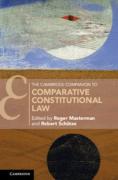
What is the purpose of comparative constitutional law? Comparing constitutions allows us to consider the similarities and differences in forms of government, and the normative philosophies behind constitutional choices. Constitutional comparisons offer 'hermeneutic' help: they enable us to see 'our' own constitution with different eyes and to locate its structural and normative choices by references to alternatives evident in other constitutional orders.
This Cambridge Companion presents readers with a succinct yet wide-ranging companion to a modern comparative constitutional law course, offering a wide-ranging yet concise introduction to the subject. Its twenty-two chapters are arranged into five thematic parts: starting with an exploration of the 'theoretical foundations' (Part I) and some important 'historical experiences' (Part II), it moves on to a discussion of the core 'constitutional principles' (Part III) and 'state institutions' (Part IV); finally it analyses forms of 'transnational' constitutionalism (Part V) that have emerged in our 'global' times.